This guide book is an update of Child Care in Islam, which was previously published by Al-Azhar in cooperation with the United Nations Children’s Fund (UNICEF) in the year 1405 Hijrah (1985 AD).
The previous document constituted an important advocacy and information tool for the Islamic world. Over 20 years, global developments and the emergence of several pressing issues necessitated the re-evaluation of the previous manual and its content, in order to meet the challenges confronting our children, who are the youth of tomorrow and the adults of the future.
The guide book comprises four themes:
child rights
child health
child protection
child education
Care was taken to keep the discussion of these themes brief, simple and supported by evidence from the Noble Qur’an, the Noble Prophetic Sunna (practices) and the Noble Hadiths. A summary of each theme appears at the end of the book. This guide book was principally designed for the use of the wide-ranging groups of people who serve the cause of the Muslim child. They include: theologians and imams (mosque prayer leaders), who preach protection and care for children; health care providers; governmental and non-governmental organizations that work in the field of child care; policy makers and programme formulators who address the rights and needs of childhood; international agencies working in the field of childhood; and experts and individuals concerned with children’s issues both inside and outside the Muslim world.
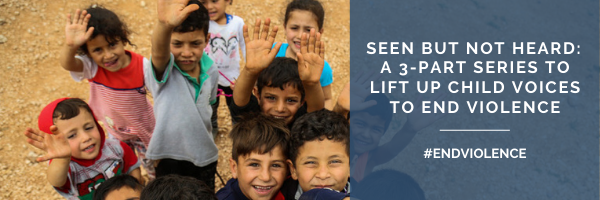
La participación infantil es un pilar fundamental para prevenir y poner fin a la violencia contra los niños y las niñas. El Centro de aprendizaje Para poner Fin a la Violencia contra la Niñez (EVAC) de JLI invitó a niños y niñas de todo el mundo a compartir sus reflexiones sobre la participación infantil, durante nuestro último seminario web de la serie Vistos pero no escuchados: Una serie de 3 partes para alzar las voces de los niños y las niñas para poner fin a la violencia.
Enlace relacionado: Guía de Evidencia de JLIsobre el papel de las comunidades de fe para poner fin a la violencia contra los niños y las niñas, para aprendizajes clave, estudios de casos y datos del Estudio de Impacto de JLI para Poner fin a la Violencia Contra los Niños y las Niñas.
Diálogo Intergeneracional sobre Participación Infantilreunió a practicantes y legisladores en conversaciones con niños bahá’ís, cristianos y musulmanes de Chile, Sudáfrica y Pakistán.
Entre los panelistas del taller, se incluyeron los siguientes:
Niños y niñas de la Comunidad Bahá’í en Chile con la Sra. Loreto Jara, de la Comunidad Bahá’í en Chile
Niños y niñas de la comunidad musulmana en Pakistán con la Sra. Afshan Jamal, Islamic Relief, Pakistán
Niños y niñas de diversas comunidades religiosas en Sudáfrica con la Sra. Christina Nomdo, Comisionada para la Infancia, Cabo Occidental, Sudáfrica
A los niños y niñas se les presentaron una serie de preguntas sobre la participación infantil en sus comunidades.
Pregunta: ¿Por qué es importante escuchar las voces de los niños y las niñas?
Un niño subrayó un impacto clave de dar plataforma a las voces de los niños. “[Si] los adultos escuchan nuestras voces… esto aumentará nuestra confianza en nosotros mismos”. Sin embargo, una niña de Pakistán señaló la importancia de adoptar un lente sensible al género al promover la participación infantil, y señaló que en su comunidad las voces de los niños a menudo tenían más peso que las de las niñas.
Pregunta: ¿Cómo crea su comunidad espacios para la participación infantil?
Los niños y niñas compartieron algunos ejemplos de cómo su comunidad apoyaba o alentaba la participación infantil, pero también sus preocupaciones sobre dónde sentían que faltaba apoyo para la participación infantil.
Una niña de la comunidad bahá’í de Chile habló de cómo los adultos de su comunidad siempre piden la opinión de los niños y las niñas. “Ellos quieren saber qué es lo que pensamos No solo nos ignoran ”. Se invita y anima a los niños y a las niñas a contribuir en las oraciones comunitarias. Un niño musulmán de Sudáfrica repitió cómo los niños participaban en las oraciones comunitarias en la mezquita.
Sin embargo, algunos de los niños y niñas identificaron deficiencias en el enfoque de su comunidad hacia la participación infantil. Las niñas y niños de Pakistán dijeron que, si bien tenían algunas oportunidades de participar, estas oportunidades no eran suficientes y que, con demasiada frecuencia, se seguían tomando decisiones por los niños y las niñas sin que se les consultara. Una niña cristiana de Sudáfrica señaló que la razón por la que los niños no pueden quedarse quietos en la iglesia es porque no tienen participación allí: nunca se les pregunta qué les gustaría escuchar, cantar o ver en la iglesia.
Pregunta: ¿Qué impacto ha tenido COVID-19 en los niños y niñas de su comunidad?
Los niños y niñas tuvieron diferentes experiencias de cómo la pandemia de COVID-19 había afectado su participación en su comunidad de fe. Todos y todas habían experimentado el cierre de mezquitas, iglesias y templos. Las niñas y niños de Pakistán dijeron que si bien no había suficientes oportunidades para participar en diferentes actividades antes del COVID-19, ahora están restringidos y no pueden ir a ningún lado.
Sin embargo, algunos de los niños y niñas hablaron sobre cómo sus comunidades se habían adaptado durante la crisis de COVID-19. Los niños y niñas bahá’ís dijeron que su comunidad había cambiado los servicios a plataformas en línea como Zoom, mientras que una niña cristiana de Sudáfrica dio el ejemplo de cómo su escuela dominical ha utilizando videos y plataformas de redes sociales para continuar llegando a los niños y las niñas durante la pandemia.
Pregunta: ¿Cómo pueden los líderes religiosos mejorar la participación infantil en su comunidad?
Todas las niñas y niños estuvieron de acuerdo en la necesidad de más diálogos intergeneracionales dentro de las comunidades religiosas. Una niña bahá’í de Chile habló de la necesidad de que los líderes religiosos se involucren más en los grupos de pre jóvenes y las clases para niños y niñas; un niño cristiano de Sudáfrica recomendó más actividades de trabajo en equipo entre niños y adultos; mientras que otro niño bahá’í mencionó la necesidad de más grupos juveniles en su comunidad de fe.
Este fue un llamado compartido por los niños y niñas de Pakistán, quienes también enfatizaron el importante papel de los líderes religiosos en cambiar los comportamientos sociales y enseñar a las comunidades sobre los derechos de las niñas y los niños. Un niño bahá’í de Chile estuvo de acuerdo en que los líderes religiosos tenían un papel importante que desempeñar para garantizar que los espacios comunitarios fueran inclusivos para todos los grupos de niños y niñas, para que ningún niño o niña se quede atrás. Una niña cristiana de Sudáfrica pidió una acción más radical sobre la participación infantil, proponiendo que los líderes comunitarios deberían ceder el control de algunos servicios de la iglesia a los niños y las niñas. Ella señaló que, “la mayoría de los niños y las niñas no quieren ir a la iglesia porque sienten que… allí nadie les entiende. Pero, ¿quién comprende a los niños y niñas mejor que otros niños y niñas? ”
Después de las contribuciones de los niños y las niñas, se invitó a los profesionales y legisladores a compartir sus reflexiones sobre cómo las comunidades religiosas pueden apoyar la participación infantil, crear un diálogo respetuoso entre adultos, niñas y niños para romper las jerarquías de poder que privan de derechos a los niños y las niñas.
Vea las diapositivas del seminario web a continuación
Puede ponerse al día con nuestros dos últimos seminarios web aquí:
Intergenerational Dialogue on Child Participation: Event Summary
Child participation is a central pillar in preventing and ending violence against children. The JLI’s Ending Violence Against Children (EVAC) Learning Hub invited children from around the world to share their reflections of child participation, during our final webinar in the series Seen But Not Heard: A 3-Part Series to Lift Up Child Voices to End Violence.
Related link: view the JLI’s Evidence Guide on the role of faith communities in ending violence against children, for key learnings, case studies and data from the JLI Scoping Study on Ending Violence Against Children.
Intergenerational Dialogue on Child Participation brought together practitioners and policy-makers in conversation with Bahá’í, Christian and Muslim children from Chile, South Africa and Pakistan.
Speakers included:
Children from Bahá’í Community in Chile with Ms Loreto Jara, Bahá’í Community in Chile
Children from Muslim Community in Pakistan with Ms Afshan Jamal, Islamic Relief, Pakistan
Children from various faith communities in South Africa with Ms Christina Nomdo, Commissioner for Children, Western Cape, South Africa
The children were presented with a number of questions about child participation in their communities.
Question: Why is it important to hear the voices of children?
One child underlined one key impact of giving a platform to children’s voices. “[If] elders hear our voices…this will increase our trust for ourselves”. However, a child from Pakistan pointed out the importance of adopting a gender sensitive lens when promoting child participation, noting that in her community boys’ voices were often given greater weight than girls.
Question: How does your community make spaces for child participation?
The children shared some examples of how their community supported or encouraged child participation, but also their concerns on where they felt support for child participation was lacking.
A child from the Bahá’í community in Chile spoke of how elders in her community always ask for the opinion of children. “They want to know what you think. They don’t just ignore you”. Children are invited and encouraged to contribute to communal prayers. A Muslim child from South Africa echoed how children participated in communal prayers at the mosque.
However, some of the children identified shortcomings in their community’s approach to child participation. Children from Pakistan said that while they had some opportunities to participate, these opportunities were not enough – and that too often, decisions were still being made for children without children being consulted. A Christian child from South Africa noted that the reason children can’t sit still at church is because they have no input there – they are never asked what they would like to hear, sing or see at church.
Question: What impact has COVID-19 had on children in your community?
The children had varying experiences of how the COVID-19 pandemic had affected their participation with their faith community. All of them had experienced the closure of mosques, churches and temples. The children from Pakistan said that while there had not been enough opportunities for participating in different activities before COVID-19, now they are restricted and cannot go anywhere at all.
However, some of the children spoke about how their communities had adapted during the COVID-19 crisis. Bahá’í children said that their community had shifted services to online platforms such as Zoom, while a Christian child from South Africa gave the example of her Sunday school using videos and social media platforms to continue reaching out to children throughout the pandemic.
Question: How can faith leaders improve child participation in your community?
The children all agreed on the need for more intergenerational dialogue within faith communities. A Bahá’í child from Chile spoke of the need for religious leaders to be more involved in junior youth groups and children’s classes; a Christian child from South Africa recommended more team building activities between children and adults; while another Bahá’í child mentioned the need for more junior groups in their faith community.
This was a call shared by children from Pakistan, who also emphasised the important role of religious leaders in changing social behaviours and teaching communities about children’s rights. A Bahá’í child from Chile agreed that religious leaders had an important role to play in ensuring community spaces were inclusive for all groups of children, and that no child is left behind. A Christian child from South Africa called for more radical action on child participation, proposing that community leaders should hand control of some church services over to children. She noted that, “most children don’t want to go to church because they feel like…nobody understands them there. But who understands children better than other children?”
Following the contributions by the children, practitioners and policymakers were invited to share their reflections on how faith communities can support child participation, create respectful dialogue between adults and children, and disrupt the power hierarchies that disenfranchise children.
Child abuse is a global problem and pervades all cultures and socio-economic strata. The effects can be profound and life altering for victims. There is substantial literature from high income countries about signs of abuse, but a dearth of data from low and middle income countries like Pakistan.
This brief provides an overview on how Islamic Relief Pakistan conceptualized Protection of Children at Risk (POCAR) project to address child protection issues.
Ejemplos Prácticos de Participación Infantil: Resumen del Evento
La participación infantil es un pilar fundamental para prevenir y poner fin a la violencia contra los niños y las niñas. Muchas tradiciones de fe ofrecen perspectivas críticas sobre la importancia de una participación significativa de los niños y las niñas. Sin embargo, la aplicación práctica de la participación infantil en las comunidades de fe de todo el mundo puede ser informal o indocumentada.
Introducción a laGuía de Evidencia de JLI (en inglés) sobre el papel de las comunidades de fe en el fin de la violencia contra los niños y las niñas, para aprendizajes clave, estudios de casos y datos del Estudio de Impacto de JLI para Poner fin a la Violencia Contra los Niños y las Niñas.
El Centro de Aprendizaje para Poner Fin a la Violencia contra los Niños y las Niñas (EVAC por sus siglas en inglés) de JLI organizó su segundo seminario web en la serie Vistos pero no Escuchados: Una serie de 3 partes para levantar las voces de los niños y las niñas para poner fin a la violencia.
Ejemplos Prácticos de la Participación Infantilse reunió a un panel de profesionales de Sri Lanka, Paquistán, Nepal, Nigeria y Kenia para compartir ejemplos de la participación eficaz del niño y la niña en sus contextos locales de la comunidad de la fe. El webinar también organizó un número de sesiones interactivas, invitando a todos los participantes a que compartan sus propias experiencias sobre la participación del niño y la niña, y a que expongan los desafíos y los obstáculos que este trabajo implica.
Vea las diapositivas del seminario web a continuación o pulse el botón de descarga a la derecha.
Basándose en el Estudio de Impacto de JLI sobre la erradicación de la violencia contra los niños y las niñas, La Dra. Selina Palm de la Universidad de Stellenbosch señaló que una causa raíz de la violencia contra los niños y las niñas es la creencia de que estos son propiedad silenciosa y obediente de las personas adultas. Pidió a los participantes que consideraran dónde imaginamos a los niños y las niñas en nuestras estructuras sociales: ¿en la parte inferior de una jerarquía triangular o en el centro de un círculo?
La Dra. Palm ofreció sugerencias prácticas sobre cómo permitir la participación de los niños y las niñas como medio de protección infantil, tales como:
Involucrar a niños y las niñas en decisiones comunitarias y familiares
Equipar a los niños y las niñas como agentes de cambio
Construyendo espacios acogedores para los niños y las niñas en programas religiosos
Involucrar a los niños y las niñas en las prácticas espirituales
Promover las voces de los niños y las niñas y espacios intergeneracionales
“Algunas agencias basadas en la fe incluyeron a los niños y las niñas en sus actividades ya que vieron el poder de su influencia en el comportamiento de las personas adultas. Nosotros podemos aprender de los niños y las niñas, no solamente ellos y ellas aprender de nosotros” – Dra. Selena Palm
La Diaconisa Juliet Eneh, El Consejo Cristiano de Nigeria: Empoderar a los niños y las niñas para que conozcan sus derechos y denuncien el abuso
La Diaconisa Eneh explicó en términos generales el trabajo realizado por el Consejo Cristiano de Nigeria, que organiza talleres para niños y niñas de toda Nigeria para que puedan participar en cuestiones relativas a su bienestar, en particular la cuestión de la violencia contra los niños y las niñas.
La Diaconisa Eneh también destacó un proyecto de la Iglesia Metodista de Nigeria. Christ Careasesora a los adolescentes sobre cuáles son sus derechos, cómo protegerse a sí mismos y cómo hacer denuncias cuando están en peligro. Paralelamente a esto, también se ofreció a los cuidadores información sobre cómo denunciar casos de violencia contra los niños y las niñas.
Uno de los principales desafíos a los que se enfrentaba el desarrollo de estos proyectos es la duda de las personas adultas, quienes temían que esto haría que los niños y las niñas “expusieran” a sus familias, iglesias u organizaciones, además del estigma que esto conlleva. Para ayudar a contrarrestar esto, el Consejo Cristiano de Nigeria organiza sesiones especiales para padres, profesores y cuidadores para educarlos sobre la necesidad de permitir que se escuche la voz de los niños y las niñas.
“Creemos que cuando los niños y las niñas reciben la voz para hablar, derribará la violencia en contra de ellos y ellas” – Diaconisa Juliet Eneh
El reverendo Fred Nyabera presenta al Dr. Chintamani Yogi y el Programa de Ahorros Infantil en Nepal
La participación activa de los niños y las niñas a menudo puede requerir programas audaces y poco convencionales. El reverendo Nyabera se refirió a un programa en Nepal por el que se apoyaba a los niños para establecer mecanismos de ahorro colectivo. Después de un período de tiempo, los niños y las niñas reunieron sus fondos y los dividieron equitativamente: un tercio para sí mismos, un tercero para sus familias y un tercero para la comunidad.
La naturaleza de este proyecto permitió a los niños y a las niñas desarrollar habilidades esenciales en la consolidación de la paz y el apoyo entre pares. Sin embargo, lo más importante, según el reverendo Nyabera, permitió a los niños y las niñas expresarse sobre los problemas que más les afectaron en su hogar, escuela y vida comunitaria. Los niños y las niñas optaron por utilizar sus fondos para apoyar proyectos sobre salud y educación infantil, y el suministro de alimentos para las familias que viven en pobreza.
“Sentían que estaban contribuyendo a su sociedad. Fueron empoderados para tomar la decisión” – Reverendo Fred Nyabera
El Dr. Chintamani Yogi habló del alto estatus de los niños y las niñas dentro de la tradición hindú, donde dioses como Rama, Ganesh y Krishna son adorados en su forma infantil. Por esta razón, el Dr. Yogui centra su trabajo en empoderar a los niños y las niñas en situaciones de pobreza y sin hogar, “niños y niñas que tienen dificultades, pero tienen divinidad; niños y niñas que tienen problemas, pero tienen potencial”.
Viraj Abeysekera: Diálogo Intergeneracional y Proyectos de Construcción de Paz Infantil
Un tema común en los debates fue la necesidad de que la participación de los niños y las niñas se llevara a cabo a todos los niveles, ya sea en acciones de raíz o en foros de influencia a alto nivel. Viraj Abeysekera destacó el enfoque multifacético de World Vision para la participación infantil a través de dos estudios de casos.
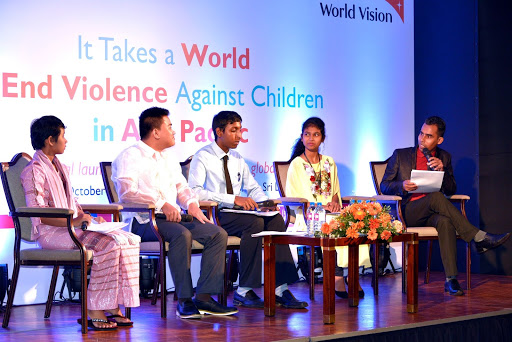
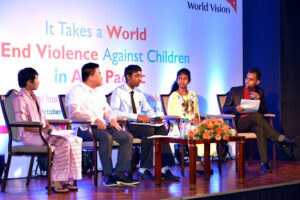
En primer lugar, la campaña mundial de World Vision, Se necesita un mundo para poner fin a la violencia contra los niños y las niñas. Una de las actividades de esta campaña consistió en reunir a líderes de la fe con niños y niñas, para abordar colectivamente el tema de la violencia contra los niños y las niñas. El diálogo intergeneracional permitió a los niños y las niñas alzar sus voces y opiniones directamente a los líderes de la fe.
En segundo lugar, un programa de construcción de paz de niños y niñas en Sri Lanka, que buscaba abordar la tensión inter comunitaria después de décadas de guerra civil. Este proyecto reunió a los líderes de la fe cristiana, budista, hindú y musulmana para crear foros interreligiosos. Los niños comenzaron a participar en proyectos en conjunto, tales como:
Limpieza de espacios públicos (por ejemplo, parques infantiles, mercados, carreteras)
Visitar niños enfermos de otros trasfondos de fe
Participar con las celebraciones y rituales de fe del otro
Abeysekera señaló el efecto dominó de estas interacciones interreligiosas dirigidas por los niños y las niñas: no sólo los niños y las niñas comenzaron a construir relaciones de confianza, sino que las comunidades en general en su conjunto comenzaron a confiar y conectarse entre sí como resultado de este programa.
Afshan Jamal: Protección de niños y niñas en riesgo en Pakistán
Afshan Jamal compartió un ejemplo de la labor de Islamic Relief Pakistán para ayudar a los niños y las niñas que se dedican al trabajo en la calle (particularmente a los que trabajan en entornos peligrosos) para que asistan a la escuela en vez de esto.
El programa ejemplificó un enfoque integrado de la participación infantil. Los niños y las niñas fueron consultados e involucrados en todas las etapas del ciclo del proyecto, mientras que las familias, las comunidades y los líderes de fe estaban comprometidos y educados para apoyar la transición. Retirar a los niños y las niñas del lugar de trabajo era un desafío, ya que muchas familias en la pobreza dependían de estos ingresos. Sin embargo, a través de intervenciones de medios de vida y de las intervenciones de enseñanza de la fe de los líderes religiosos durante los sermones de los viernes, los niños pudieron comenzar a asistir a la escuela.
El programa también fortaleció los mecanismos de protección en la comunidad, además los niños y las niñas desempeñaron un papel destacado en las campañas de protección infantil, como por ejemplo a través de un proyecto de teatro callejero.
Los participantes se dividieron en sesiones de trabajo, donde se les invitó a reflexionar sobre las siguientes preguntas:
¿Qué ha funcionado con respecto a la participación infantil para poner fin, prevenir y responder a la violencia contra los niños y las niñas, y por qué?
¿Cuáles son las barreras para la participación infantil?
¿Cuáles son las posibles soluciones?
Los participantes plantearon una serie de cuestiones, tales como:
La importancia de construir relaciones de confianza y a largo plazo con los niños y las niñas para una participación eficaz de los niños y las niñas, y los beneficios de las intervenciones a largo plazo
El papel de los testimonios infantiles, en forma de clips de vídeo, en ayudar a los adultos a entender las necesidades de los niños y las niñas (por ejemplo, durante las sesiones de entrenamiento o talleres)
El papel de los líderes de fe en las culturas desafiantes que silencian a los niños y las niñas
El desafío de deconstruir la “figura de autoridad” del adulto
El desafío de llevar a cabo una participación infantil efectiva en las iglesias, en contraste con las escuelas
La importancia de trabajar con los padres y las familias para superar los desafíos a la participación infantil
Temas particulares que los participantes consideraron necesario abordar a través de la participación infantil: salud sexual, abuso sexual, violencia doméstica y ciberacoso
La necesidad de crear espacios donde los niños y las niñas puedan tener activamente una voz
Las oportunidades y desafíos que plantean las redes sociales durante COVID-19 – por un lado, una plataforma para que los niños y las niñas compartan sus voces y cuiden de su propio bienestar. Sin embargo, también hay problemas de salvaguarda y protección, ya que se trata de un espacio de riesgo para los niños y las niñas.
El desafío de definir la “participación infantil” – en algunos contextos, sólo la consulta ligera con los niños y las niñas se considera suficiente participación infantil
La necesidad del diálogo intergeneracional, particularmente la importancia de los líderes de fe que escuchan las voces de los niños y las niñas
La necesidad de garantizar que las políticas y las leyes estén centradas en los niños y las niñas
La desconfianza que algunas comunidades de fe locales tienen de actores “occidentales” influenciados por el trabajo por la participación infantil. La necesidad de que los líderes de fe y las enseñanzas de fe construyan confianza.
Casos prácticos de participantes
Se invitó a los participantes a compartir ejemplos positivos de la participación infantil de sus propias experiencias profesionales y comunitarias. Entre ellos podemos incluir:
Practical Examples of Child Participation: Event Summary
Child participation is a central pillar in preventing and ending violence against children. Many faith traditions offer critical perspectives on the importance of meaningful child participation. Yet the practical application of child participation in faith communities around the world can be informal or undocumented.
Introducing the JLI’s Evidence Guide on the role of faith communities in ending violence against children, for key learnings, case studies and data from the JLI Scoping Study on Ending Violence Against Children.
The JLI’s Ending Violence Against Children (EVAC) Learning Hub hosted its second webinar in the series Seen But Not Heard: A 3-Part Series to Lift Up Child Voices to End Violence.
Practical Examples of Child Participation brought together a panel of practitioners from Sri Lanka, Pakistan, Nepal, Nigeria and Kenya to share examples of effective child participation in their local faith community contexts. The webinar also hosted a number of interactive breakout sessions, inviting all participants to share their own experiences of child participation, and reflect on the challenges and obstacles involved in this work.
View the webinar slides below or press the download button to the right.
Drawing on the JLI Scoping Study on Ending Violence Against Children, Dr Selina Palm of Stellenbosch University noted that a root cause of violence against children is the belief that children are the silent, obedient property of adults. She asked participants to consider where we envision children in our social structures: at the bottom of a triangular hierarchy, or at the centre of a circle?
Building child-friendly spaces in religious programmes
Involving children in spiritual practices
Promote child voices and intergenerational spaces
“Some faith-based agencies included children in their activities because they saw the power of their influence on adult behaviour. We can learn from children, not just children learning from us” – Dr Selina Palm
Deaconess Juliet Eneh, The Christian Council of Nigeria: Empowering Children to Know Their Rights and Report Abuse
Deaconess Eneh outlined the work done by the Christian Council of Nigeria, which organises workshops for children around Nigeria to enable them to participate in issues concerning their welfare – particularly the issue of violence against children.
Deaconess Eneh also highlighted a project by the Methodist Church Nigeria. Christ Carementors teenagers on what their rights are, how to protect themselves and how to make reports when in distress. Parallel to this, caregivers were also offered information on how to report cases of violence against children.
One of the primary challenges faced in delivering these projects was the hesitancy of adults, who feared this would lead to children “exposing” their families, churches, or organisations, and the stigma attached to this. To help counter this, the Christian Council of Nigeria organises special sessions for parents, teachers and caregivers to educate them about the need to allow the voice of children to be heard.
“We believe that when children are given the voice to speak, it will bring down violence against them” – Deaconess Juliet Eneh
Reverend Fred Nyabera introducing Dr Chintamani Yogi and Child Savings Programme in Nepal
Active child participation can often require bold and unconventional programmes. Reverend Nyabera referenced a programme in Nepal whereby children were supported to set up collective savings mechanisms. After a period of time, the children gathered their funds and divided them equitably: a third for themselves, a third for their families and a third for the community.
The nature of this project enabled children to develop essential skills in peacebuilding and peer support. However most crucially, according to Reverend Nyabera, it enabled the children to express themselves about the issues that affected them most in their home, school and community lives. The children chose to use their funds to support projects on child health, child education and provision of food for families in poverty.
“They felt that they were contributing to their society. They were empowered to make the decision” – Reverend Fred Nyabera
Dr Chintamani Yogi spoke of the high status of children within Hindu tradition, where Gods such as Rama, Ganesh and Krishna are worshipped in the form of children. For this reason, Dr Yogi focuses his work on empowering children in situations of poverty and homeless – “children who have difficulty, but they have divinity; children who have problems, but they have potential.”
Viraj Abeysekera: Intergenerational Dialogue and Child Peacebuilding Projects
A common theme in the discussions was the need for child participation to happen at all levels – whether in grassroots actions or in high-level influencing fora. Viraj Abeysekera highlighted World Vision’s multifaceted approach to child participation through two cases studies.
First, World Vision’s global campaign, It Takes a World to End Violence Against Children. One of the activities of this campaign involved bringing faith leaders and children together, to collectively address the issue of violence against children. The intergenerational dialogue enabled children to raise their voices and opinions directly to faith leaders.
Second, a child peacebuilding programme in Sri Lanka, which sought to address inter-communal tension following decades of civil war. This project brought together Christian, Buddhist, Hindu and Muslim faith leaders and children to create interfaith forums. The children began engaging in projects together, such as:
Cleaning up public spaces (e.g. playgrounds, markets, roads)
Visiting sick children from other faith backgrounds
Engaging with each other’s faith celebrations and rituals
Abeysekera noted the ripple effect of these child-led interfaith interactions: it was not just the children who began to build trusting relationships, but the broader communities as a whole began to trust and connect with one another as a result of this programme.
Afshan Jamal: Protecting Children at Risk in Pakistan
Afshan Jamal shared an example of Islamic Relief Pakistan’s work to assist children engaged in street work (particularly those working in hazardous environments) to attend school instead.
The programme exemplified an integrated approach to child participation. Children were consulted and involved at all stages of the project cycle, while families, communities and faith leaders were engaged and educated to support the transition. Removing children from the workplace was challenging, as many families in poverty depended on income. However, through livelihoods interventions, and the faith-teaching interventions of religious leaders during Friday sermons, children were enabled to start attending school.
The programme also strengthened protection mechanisms in the community, and children played a leading role in child safeguarding campaigns, such as through a street theatre project.
Breakout session discussions (click the arrow to see the responses):
The participants divided into breakout sessions, where they were all invited to reflect on the following questions:
What has worked with regards to child participation to end, prevent, and respond to violence against children and why?
What are the barriers to child participation?
What are the possible solutions?
Participants raised a number of issues, such as:
The importance of building trusting, long-term relationships with children for effective child participation, and the benefits of long-term interventions
The role of child testimonials, in the form of video clips, in helping adults understand children’s needs (e.g. during training sessions or workshops)
The role of faith leaders in challenging cultures that silence children
The challenge of deconstructing the “authority figure” of the adult
The challenge of conducting effective child participation in churches, versus in schools
The importance of working with parents and families to overcome the challenges to child participation
Particular topics that participants felt needed addressing through child participation: sexual health, sexual abuse, household violence, and cyberbullying
The need to create spaces where children can actively have a voice
The opportunities and challenges posed by social media during COVID-19 – on the one hand, a platform for children to share their voices and take care of their own wellbeing. However, there are also safeguarding and protection concerns as this is a risk space for children.
The challenge of defining “child participation” – in some contexts, only light consultation with children is considered sufficient child participation
The need for intergenerational dialogue, particularly the importance of faith leaders listening to children’s voices
The need to ensure policies and laws are child-centred
The mistrust some local faith communities have of “Western”-influenced actors working for child participation. The need for faith leaders and faith teachings to build trust.
Participant Case Studies
Participants were invited to share positive examples of child participation from their own professional and community experiences. Some of these include:
A common value shared across diverse people of faith is the belief that each person, regardless of age, has infinite value, dignity and worth. The responsibility to care for and protect vulnerable children also forms an explicit mandate in many faith traditions. Although violence against children is a global epidemic, such violence is preventable. In a world where 84% of people identify as religious, faith communities have a unique, essential and indispensable role to play in ending violence against children. They can be first responders to recognise, refer, report and respond to this violence, but can also play critical roles in changing harmful practices, bridging gaps between formal and informal child protection systems, and serving as advocates for and with children at many levels. Faith actors have unique spiritual roles to play nurture positive beliefs around the protection and care of children and to tackle and transform harmful underlying beliefs that still perpetuate or enable violence. This is already happening in many places. But they must be further equipped. More research is essential to understand current gaps, new threats and to robustly document their existing diverse roles.
This report is centred on a project to Reduce Human Trafficking in Marginalised Communities of Rautahat District. Rauthat is a multi-ethnic, multilinguistic district on the border with India. It is also home to some of the most marginalised groups in Nepal, including Dalit and Janajati castes and Muslim communities. Islamic Relief along with its partner, the Rural Development Centre, is implementing a project preventing and responding to trafficking in children and the worst forms of child labour, through community-based integrated response mechanisms. The intervention is aimed at supporting vulnerable children and their families through specialised protection schemes that include education, livelihoods, skills training and psychosocial support.
Suggestions and good practices for Sunday schools, church-run schools and summer camps to implement the “Churches’ Commitments to Children”
This toolkit provides resources for churches, church-run schools, and summer camps to support intergenerational climate and environmental justice and promote care for children by stopping further global warming. All churches are encouraged to promote education and action to address climate change, reduce CO2 emissions, and protect the environment in their activities for and with children and youth.
The resource has three main sections:
GET INFORMED. This section includes resources available to educate children of various age groups about climate change and environmental challenges.
GET INSPIRED. This part presents inspiring initiatives happening around the world, from global movements to church communities and small groups of individuals.
TAKE ACTION. This section illustrates that, from small acts to major movements, everyone can do their part to address environmental challenges and promote behaviours and choices that respect creation. Anyone can help to stop global warming

 musulmana para crear foros interreligiosos. Los niños comenzaron a participar en proyectos en conjunto, tales como: