On 16 October 2019, ED Fore met with leaders of faith-based organizations in Washington, D.C., to launch Faith and Positive Change for Children – a Global initiative on Social and Behaviour Change (FPCC), a partnership between UNICEF, Religions for Peace and the Joint Learning Initiative on Faith and Local Communities.
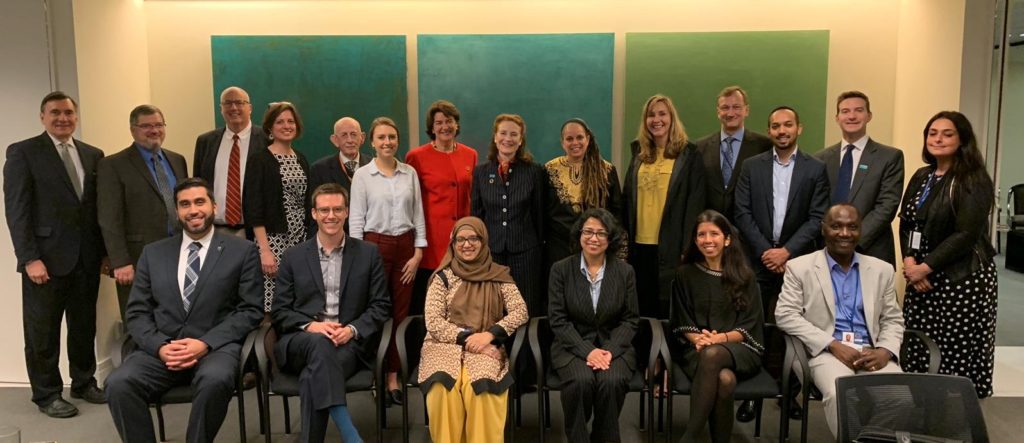
ED Fore launches the Faith and Positive Change for Children Global Initiative in Washington, D.C.

ED Fore launches the Faith and Positive Change for Children Global Initiative in Washington, D.C.

The purpose of the initiative is to put into motion a new way of engaging with Faith leaders and local faith communities.

In his statement for the launch, Imam Mohamed Magid, Co-President, Religions for Peace expressed the privilege he felt working alongside UNICEF as a convening partner for the initiative. “Religions for Peace is the largest inter-faith network in the world and with its country presence and inter-religious councils in numerous countries we take this opportunity to publicly re-commit the support of RfP worldwide to the roll-out of the initiative,” he said.

The FPCC has spent two years generating rigorous evidence, including literature review, mapping of country level work, analysis of resource materials, case study documentation, and consultations with a global advisory group of over 15 global partner faith-based organizations. It is now positioned to further refine and validate its preliminary Theory of Change and comprehensive Principles Paper, both developed to guide more meaningful, equitable and sustainable ways of working with Faith actors towards positive change for children.

Last week, the first of a series of consultations, “Work Rocks” was convened in South Sudan, opened by the country’s Vice President and three Ministers. The series of four-day inter-faith gatherings are being organized in six focal countries in Africa by UNICEF’s Communication for Development Section in collaboration with Civil Society Partnerships (CSP) Unit, Division of Communication and global faith
partners.

“We are calling these kick-off gatherings ‘Work Rocks’ to purposefully seed the idea that this effort is about laying deeper and stronger foundations to ensure sustained partnerships for social and behaviour change from within faith communities,” explained Kerida McDonald, acting Chief of Communication for Development for UNICEF.
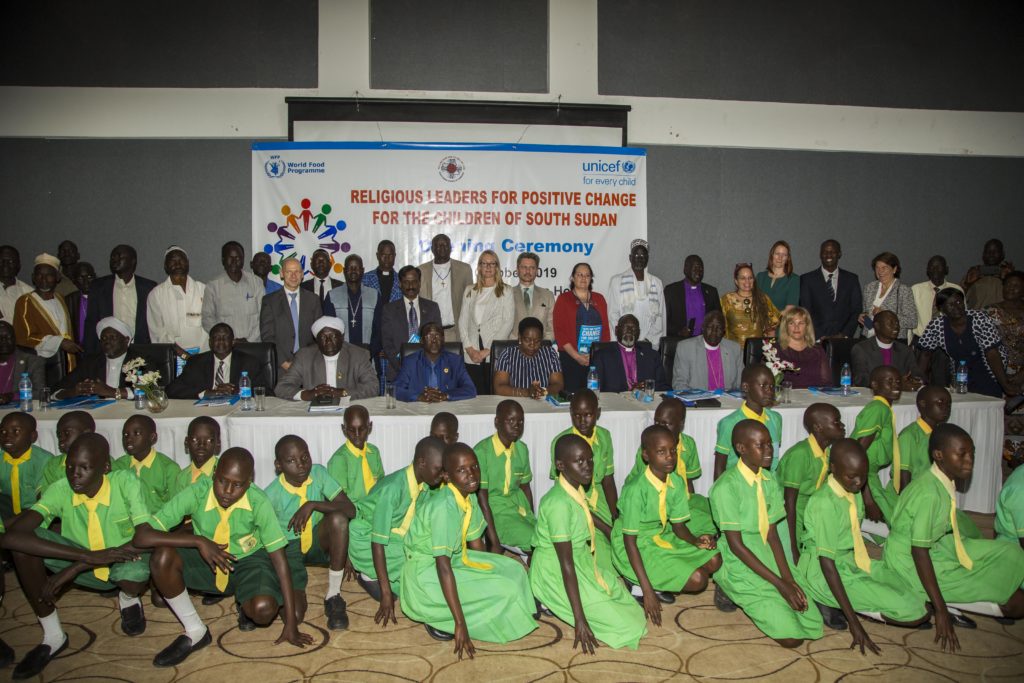
“Work Rock” foundational change meeting in
South Sudan with children from JCC Primary School

“The aim is to move away from top-down, message-focused, short-term, project mode, sector-siloed and instrumentalist-type engagement with religious leaders which has been characteristic of much of the well-intentioned efforts of country offices to leverage the power of religious leaders in addressing attitudinal and behavioural barriers to achieve programmatic goals.”

At the Global launch of the initiative, hosted by ED Fore, a core representative from the Advisory Group, Sunita Groth, Senior Program Manager of World Vision, lauded the initiative as a unique effort within UN and Development programming to build on lessons learned. “We acknowledge the powerful role that religion can play, for good or for ill,” she said. “We also have learned that we should not impose our own values and ‘development-speak’ on faith leaders and their faith communities.” Ms. Groth went on to stress the value of partnering faith and science to address the issues facing communities.

“We need to come together in true partnership and allow faith leaders to discover the barriers to the change they want to see for families and communities and how to influence these through their own religious texts, grounded in science, and facing the real-life reality of people in their communities,” she said.
Adding, “We have evidence that this type of approach works in influencing concrete change.”
A longitudinal study in Senegal showed 72 per cent of faith leaders and spouses were reported to have stopped hitting or insulting their children, while those believing that faith leaders who abuse children should not be punished dropped from 66 per cent to 15 per cent.

“This is the most important thing I’ve worked on in all my years of faith and development,” said Jean Duff, Executive Director of the Joint Learning Initiative on Faith and Local Communities and UNICEF’s Knowledge partner for the initiative. “The initiative has unprecedented potential for providing a bridge of collaboration across multi-laterals, government and faith organizations; in breaking dependency mindsets through mind and heart dialogue grounded in assets of the community; by re-framing from training to learning, testing and doing; and for creating a strong mechanism for scaling up by joining action across three tiers – global, regional and country level.”

In her closing remarks, ED Fore encouraged partners to continue guiding UNICEF on how the organization needs to remodel its relationships with faith communities for benefit of children. “We count on you all to help us cement the true partnerships we are seeking in order to more effectively address the deep-rooted cultural, social and behavioural issues that undermine even the best efforts of our programmatic work,” she said. “It is fitting that we are staging this global launch of the FPCC initiative during the momentous year of the 30th anniversary of CRC…we take this opportunity to join hands with you today in recommitting our focus and energies to work together more closely and more effectively to ensure the rights and well-being of the world’s most vulnerable children.”

by Kerida McDonald, Senior Adviser Communication for Development

Repost from UNICEF Icon

View more about the FPCC

Salt Lake City 2019

JLI Partner Soka Gakkai International (SGI) convened two events at the recent UN Civil Society Conference.


The Power of Faith Actors to Promote Resilient Cities & Communities

Moderated by Nobuyuki Asai, Director for Humanitarian Affairs and Sustainable Development, Office of Peace and Global Issues.


Speakers:

  • Vanessa Pizer, Senior International Program Officer, Episcopal Relief and Development (ERD), ERD partner ecare’s work in the Philippines.
  • Jason Alfonse Fileta, Vice President, Tearfund USA, Tearfund’s garbage project in Pakistan and Rubbish advocacy campaign in the UK.
  • Bruce Knotts, Director, Unitarian Universalist (UU) UN Office, UU’s humanitarian activities.


Vanessa Pizer described disaster relief and recovery using an asset-based approach in the Philippines following Typhoon Haiyan. The development arm of the Episcopal Church in the Philippines, ecare, uses a“R2G” (Receivers to Givers) model, designed to develop dignity and generate hope and empowerment.

Jason Fileta outlined Tearfund’s work supporting Haryali garbage collectors in Karachi which lessens the burning of toxic material and increases recycling, and the Rubbish advocacy campaign in the UK to push major companies to reduce the production of plastic bottles.

Bruce Knotts described UU initiatives including support to orphaned children in Ghana through the Queen Mothers, assistance for LGBT asylum seekers, and the “No More Deaths” program where volunteers leave water in the desert for people crossing the border into the USA.

The Q and A session considered what added value faith groups bring. The speakers stressed that faith groups have been involved in support to the vulnerable in societies since long before NGOs appeared, that their contributions are longer-term and linked to human qualities such as dignity and hope. Also, advocacy linked to religious beliefs outlasts other forms. Nobuyuki Asai also described the contributions of FBOs in Japan including Soka Gakkai following the 2011 earthquake and tsunami disaster.

Post-session action will be to continue to share lessons learnt and experiences of success through such exchanges between different faith actors and through the Joint Learning Initiative on Faith & Local Communities (JLI) that was a co-organizer of this workshop.


Amazon Frontline Report: Challenges and Partnerships for Sustainability in Manaus, Brazil’s Amazonas State

Joan Anderson, Senior Coordinator for Peace and Global Issues, Soka Gakkai International moderated the session

Speakers

  • Tais Tiyoko Tokusato, Environmental Education Programs Coordinator at the Soka Institute for Environmental Studies and Research of the Amazon, environmental education programs and reforestation project
  • Cintia Okamura, PhD, a community participation expert from the Environmental Agency of the State of São Paulo, sustainable community projects
  • Denise Machado Duran Gutierrez, PhD, Social Technology Coordinator at the National Institute of Amazonian Research (INPA), developing social technologies with local people

Panelists spoke of the challenges and successes of their grassroots efforts in Manaus City and gave examples of partnerships developed to help carry out the work in their communities. All the case studies presented effective partnerships which can be linked to SDG 17. Tais spoke of the Institute’s environmental education programs with the community and reforestation projects, stressing that partnerships have been the key to their success. There was a short video message by Adalberto Carim Antonio, Chief Judge of Specialized Court of Environment and Agrarian Issues of Amazonas who highlighted Soka Institute’s “Seeds of Life” reforestation project in Manaus, and the night school where environmental criminals are exposed to environmental education to positive effect. Dr. Okamura explained the process of developing a sustainable project in Aleixo Lake by bringing its residents, companies and government institutions together in partnership to find solutions. Dr. Gutierrez introduced three concrete examples of social technologies, which integrates scientific knowledge with traditional knowledge, created with local people in the Amazon region.

On July 23, 2019, JLI held a webinar on Climate Advocacy and Faith Work. This is the fourth and final webinar of the climate series on practice, policy, and academia.


Dr. Olivia Wilkinson, JLI Director of Research moderated the webinar.

Speakers:

Isaiah Toroitich, Head of Advocacy and Development Policy, ACT Alliance

  • Presentation: Justice as Basis for Climate Advocacy [3:25 – 19:30]

Sarah Wiggins, Global Advocacy Team Co-Leader, Tearfund

  • Presentation: Advocacy on Climate Change – Our Lessons [19:52 -34:40]

Hellen Mugo, Acting Director of Research and Partnership, Catholic Youth Network for Environmental Sustainability in Africa (CYNESA)

  • Presentation: Catholic Youth Network for Environmental Sustainability in Africa (CYNESA)  [35:08 – 48:24]

Questions and Answers and next steps discussion [48:30]


Share with your networks!


Related Resources

Tearfund Climate Advocacy Tools Tearfund Advocacy Toolkit – Second Edition & Live Justly Tearfund Advocacy Toolkit – Second Edition Live Justly – Global Edition
Alternative narratives: Restoration Story
Movement Building Agenda including Bootcamp agenda MOVEMENT BUILDING GUIDE – Mobilising ordinary people as agents for widespread change
Renew Our World Renew Our World webpage
ACT Alliance Resources
Enhanced Climate Action in Response to 1.5°C of Global Warming, Scaling Up Nationally Determined Contributions & Climate Change Advocacy Framework Position (2016 – 2018) Enhanced Climate Action in Response to 1.5°C of Global Warming, Scaling Up Nationally Determined Contributions Climate Change Advocacy Framework Position (2016 – 2018)
  Towards the Ambitious Implementation of the Paris Agreement – A Toolkit for National Level Advocacy Towards the Ambitious Implementation of the Paris Agreement – A Toolkit for National Level Advocacy
ACT Alliance with Bread for the World Analysis: The Paris Climate Agreement – Towards a climate-friendly future & Policy Brief Analysis: The Paris Climate Agreement – Towards a climate-friendly future Policy Brief – PROTECTED AGAINST CLIMATE DAMAGE?
  ACT Alliance EU Position Paper – Food Security and Climate Change


ACT Alliance EU Position Paper – Food Security and Climate Change
  Non Economic Loss and Damage & Limiting Global Warming to 1.5C Non-Economic Loss And Damage Study-Limiting Global Warming to 1.5°C-The Climate Risks and Irreversible Losses We Must Avoid


On June 18, 2019, JLI held a webinar on Applied Climate and Faith Research. This is the third webinar of a four part series that is structured around the domains in which JLI aims to draw from and have an impact: practice, policy, and academia.

Dr. Olivia Wilkinson, JLI Director of Research moderated the webinar.

Speakers:

Professor Evan Berry, Associate Professor and Director of Graduate Programs in the Department of Philosophy and Religion at American University

  • Presentation: Applied Academic Research Faith and Climate [4.15 – 18:15]
  • Contact: evan.berry@asu.edu

Ulil Amri, University of Washington, Indonesian Institute of Sciences

  • Presentation: Pesantren’s religious environmentalism and renewable energy project in Indonesia [19:03 -29:05]

Vanessa Pizer, Senior International Program Officer, International Programs, Episcopal Relief & Development

  • Presentation: Making the most of Research – A focus on partnership, process & learning: Observations from a climate resilience scoping study  [29.50]

Related Resources

Episcopal Relief and Development Tools (below) and Curriculum

Climate Resilience Participatory Learning & Action Tools


Please register for the upcoming webinar on July 23, 2019.


Background

In October 2018, the UN’s Intergovernmental Panel on Climate Change (IPCC) published a special report on Global Warming of 1.5˚C, which is predicted by 2030-2052 which is predicted by 2030-2052. This warming will cause sea level rise, drought, and other effects that will have impacts on people worldwide. The effects will be even more severe if there is global warming of 2˚C. There is an urgent need to curb anthropogenic emissions that are causing these long-lasting effects on the earth’s climate system.

Local faith communities are already heavily impacted by climate change. They are also increasingly involved in the action on climate change, bringing religious motivations to understandings of stewardship and care for our planet. Faith-based NGOs are working to mitigate climate change, help climate change adaptation in communities, and mobilize and faith communities towards advocacy for change, as well as implementing climate-sensitive ways of operating in their humanitarian and development operations. Yet much remains to be done in the humanitarian and development fields where the climate is frequently acknowledged as one of the most pressing issues of our time but little has changed from the status quo.

JLI is an international collaboration committed to convening academics, practitioners, and policymakers to examine the research and evidence on the role of religion in humanitarian and development aid. In the past year, many members have asked us to consider topics such as climate change, climate justice, the environment, and ecology as future interests for a possible Learning Hub.

We recognize that there is already a lot of work and research in the area of faith and climate. We believe that the JLI’s convening mechanisms can offer added value by focusing in on the specific intersections of climate, faith-based international humanitarian and development work, and a focus on research and evidence.

BEIRUT, LEBANON:

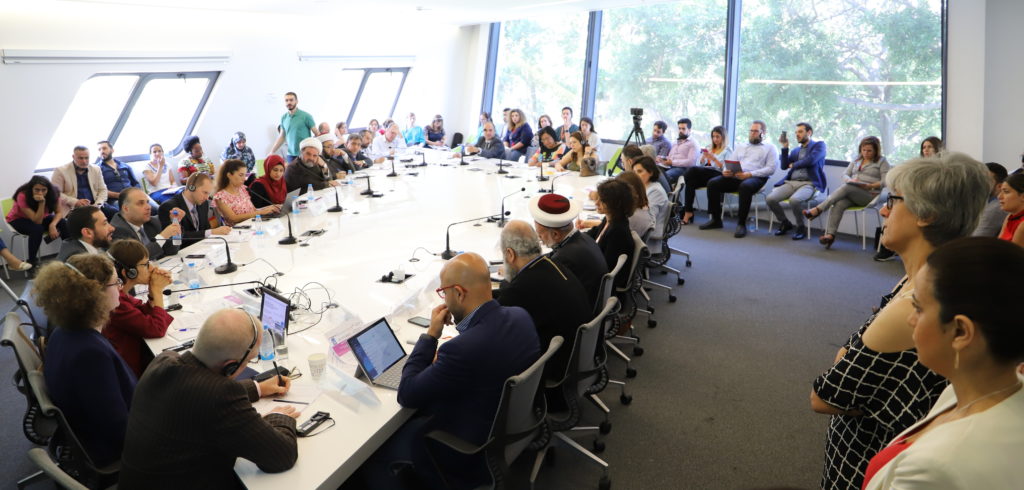
Leading members from Lebanon’s diverse network of religious institutions came together on Tuesday to stress the crucial role that faith plays in responding to the refugee crisis and to urge for faith to be better integrated into the mainstream refugee response.

Representatives from UNHCR and the Ministry of Social Affairs, Christian, Sunni and Shia faith leaders, as well as aid groups with and without religious foundations all stressed how faith should play a pivotal role in reducing the strain of displacement and war and be used as a tool to better integrate arrivals into host communities, as well as in preventing conflict in the first place.

The Role of Local Faith Actors in Implementing the Global Compact on Refugees event was co-hosted by the Joint Learning Initiative on Faith and Local Communities (JLI), World Vision, Islamic Relief Worldwide, Kaiciid Dialogue Centre, the Middle East Council of Churches and ACT Alliance. Dozens of faith representatives, leaders from faith-based and secular humanitarian agencies as well as multiple UN agencies and government representatives all attended the consultation at AUB’s Issam Fares Institute.

Faith and humanitarian organizations discuss refugee response in beirut

pc: World Vision Lebanon

UNHCR’s Representative in Lebanon Mireille Girard said: “At a time of unprecedented displacement across the world, there is a growing consensus that we need to work together towards more effective responses. The Global Compact for Refugees recognises that we need to do better. We all have a role to play and need to mobilise everyone.

“Faith-based organisations are relevant throughout this cycle of displacement – from arrival, to eventual return. Faith-based organisations have a sound knowledge of the context and have a lot of experience in relief support. They also have a role to play in conflict prevention and reconciliation where they can be especially relevant.

“With economic crises and unemployment prevailing in many parts of the world, refugees are increasingly being stigmatised and seen as the reason for these economic crises. These sentiments are widespread so we have to ask ourselves what we can do together to address this phenomenon.”

Robin Sghbini, the Minister of Social Affairs representative and the Head of the Resettlement Response Plan in Lebanon, stressed that religious leaders have an important role to play because they exert great influence in their local communities.

“Their role is not only to ease tensions between the displaced and the host communities, but to reach cooperation in order to resolve other societal issues affecting the refugee community,” he said. “In the past the ministry of social affairs has cooperated with many religious leaders to protect children and women from early marriage and other social and humanitarian issues that protect and support refugees in Lebanon.”

Sghbini also welcomed the idea of partnership between religious leaders and other institutions concerned with the protection of refugee rights because “the crisis of displacement has reached its maximum and we need to join all our efforts”.


Professor Elena Fiddian-Qasmiyeh, Academic Chair of the JLI’s Refugee and Forced Migration Hub, Professor of Migration and Refugee Studies and Co-Director, UCL-Migration Research Unit University College London, said:

“When a person is forced to leave their home and their country in search of refuge and international protection, they are uprooted from their relatives, communities and lives. Often, they will see loved ones killed or injured and face immense barriers as they seek safety. The distress that these experiences and barriers cause is profound, often leaving people struggling to cope in their new surroundings.

“In times like these, faith is one of the only things that many people have left. Yet all too often even this is restricted as people lose access to religious support when they are displaced. What we have seen around the world, though, is that faith can be a key tool in helping people to recover and pursue their quest for protection and social justice. We have also seen that, when harnessed effectively, faith can bring communities together and help prevent future conflict.

“The international community has already recognised the role of faith actors in the Global Compact on Refugees, but it is up to us to ensure that displaced people are able to seek, and be granted, protection, to translate these noble words and intentions into concrete actions.”

The Global Compact for Refugees (GCR), agreed by the world at the end of 2018, acknowledges the role faith actors play in helping refugees and host communities all over the world, but the compact is non-binding.

To truly maximise the impact that faith actors in global refugee response Prof. Elena Fiddian-Qasmiyeh said that the research that has been conducted by the JLI Refugees and Forced Migration Hub shows that:

  • Humanitarian actors and other institutions need to recognise faith actors in all aspects of refugee response and ensure that faith actors are able to meaningfully take part and share responsibility.

  • International actors should expand engagement with faith actors, especially local faith actors in refugee response, with donor agencies stepping up support to build the capacity and compliance of those on the ground.

  • Financial barriers that exclude and discriminate against faith-based organisations need to be removed and donors must support faith actors that provide key services in support of refugees and members of host communities.

  • Access to spiritual support must be available to displaced people alongside psycho-social and humanitarian support.

  • Faith leaders need to be recognised for the role they can and do play in promoting Gender Justice, often countering – not advocating for – issues like FGM and child marriage.

  • Inter- and multi-faith initiatives should be supported to aid integration in host countries and help reconciliation upon return.


Many speakers were careful to stress that they felt xenophobia, racism and Islamophobia, in particular, were all on the rise, across the world but also across the Middle East.


Ziad el Sayegh, Policies and Communication Advisor, Middle East Council of Churches:

“The Global Compact for Migrants and Refugees is built on the obligation to respect human dignity and peace in society and to implement justice; these are fundamental values in all religions.

“It is absolutely impossible for religious authorities not to make the choice of promoting hope and moving people away from xenophobia, especially when accompanying the migration and refugee crises.

“It is impossible to solve the political and security crises through a mere economic and social approach. Solutions should be inspired by the religious fundamentals of human dignity, going back to the roots of ethical bases. This is the role of religious authorities when it comes to converging with the content of the Global Compact for Migrants and Refugees.”

Sheikh Hassan Dalli, of Lebanese organization Iftaa House, and the Mufti of Hasbaya and Marjeeyoun, meanwhile stressed that the Syrian conflict forced many to flee due to internal Syrian matters, but that it was important for all to be concerned for the safety and wellbeing of those who had fled seeking a safer place for their family and children.

“This was our humanitarian duty to receive the Syrian refugees in Lebanon as many countries did and to provide what is necessary to preserve their lives,” he said. “Similar circumstances have happened throughout history during wars and its hardships.”

This event is made possible by support from the Henry Luce Foundation

For more information or to arrange an interview please contact: rima@jliflc.com

To find out more about how faith actors can help deliver on the Global Compact please read the Joint Learning Initiative Refugee Hub’s policy brief.  

اقرأ الخبر الصحفي هنا بالعربي

On May 21, 2019, JLI held a webinar on faith-based climate programs. This is the second webinar of a four part series that is structured around the domains in which JLI aims to draw from and have an impact: practice, policy, and academia.

Dr. Olivia Wilkinson, JLI Director of Research moderated the webinar.

Speakers:

Leo Dee: Project Coordinator for Eco Tourism and Eco Bible Commentary, The Interfaith Center for Sustainable Development

  • Presentation: Interfaith Sustainability in Practice Access Gap [4.12 -16.34]
  • Overview of interfaith programs at the Interfaith Center for Sustainable Development. Micro: Women educators- Sustainability for the classroom, Meso: Renewable Energy through Solar panels with Anglican communities in Rwanda, Macro Sustainability & water systems in Jeruselum

Rev Fletcher Harper: Executive Director, GreenFaith

  • Presentation: GreenFaith Interfaith Partners for the Environment [17.28 -28.16]
  • Introduction to Greenfaith, seminary initiative to integrate environmental issues into religious leaders’ education and training, religious teachings resources

Dr. Iyad Abumoghli: Principal Advisor, UN Environment

  • Presentation: Faith for Earth Initiative [29.08]
  • Why we need a transformational revolution – strategic goals of Faith for Earth Initiative and examples of FBO involvement

Please register for the upcoming webinars on June 18 and July 23, 2019.


Background

In October 2018, the UN’s Intergovernmental Panel on Climate Change (IPCC) published a special report on Global Warming of 1.5˚C, which is predicted by 2030-2052 which is predicted by 2030-2052. This warming will cause sea level rise, drought, and other effects that will have impacts on people worldwide. The effects will be even more severe if there is global warming of 2˚C. There is an urgent need to curb anthropogenic emissions that are causing these long-lasting effects on the earth’s climate system.

Local faith communities are already heavily impacted by climate change. They are also increasingly involved in the action on climate change, bringing religious motivations to understandings of stewardship and care for our planet. Faith-based NGOs are working to mitigate climate change, help climate change adaptation in communities, and mobilize and faith communities towards advocacy for change, as well as implementing climate-sensitive ways of operating in their humanitarian and development operations. Yet much remains to be done in the humanitarian and development fields where the climate is frequently acknowledged as one of the most pressing issues of our time but little has changed from the status quo.

JLI is an international collaboration committed to convening academics, practitioners, and policymakers to examine the research and evidence on the role of religion in humanitarian and development aid. In the past year, many members have asked us to consider topics such as climate change, climate justice, the environment, and ecology as future interests for a possible Learning Hub.

We recognize that there is already a lot of work and research in the area of faith and climate. We believe that the JLI’s convening mechanisms can offer added value by focusing in on the specific intersections of climate, faith-based international humanitarian and development work, and a focus on research and evidence.

On April 23rd, 2019, JLI held a webinar on faith-based climate programs. This is the first webinar of a four part series that is structured around the domains in which JLI aims to draw from and have an impact: practice, policy, and academia.

The webinar was convened by Dr. Olivia Wilkinson, JLI Director of Research

Speakers:

Gopal Patel: Director of the Bhumi Project, a joint-initiative of the Oxford Centre for Hindu Studies and GreenFaith

  • Presentation: Rise to Shine: The role of Indian Religious Institutions in Closing the Energy
    Access Gap [0.30 -17.00]
  •  Learn about a survey of 30 faith organisations in India to map current work and programs on renewable energy and partnerships

Chantal Elkin: Director of the Wildlife Programme at the Alliance of Religions and Conservation (ARC)

  • Presentation: Islamic Approaches to Conservation in Indonesia (17.00 -36.00]
  • Overview Indonesia’s work with Muslim Leaders and climate change especially with the national Islamic authority (MUI) which is made of 800,000 mosques and 80,000 Islamic schools work. Current work through training and increasing the knowledge of local leaders in conservation issues and fatwas.

Stephen Tasker: Country Director, Adventist Development and Relief Agency (ADRA), Solomon Islands

  • Presentation: Model Community Development Program: Working with a local faith community on climate change adaptation in the context of a model community development program [36.00]
  • Case study on the South Sea Evangelical Church integrated development programme to reduce climate change in the Solomon Islands.


Background

In October 2018, the UN’s Intergovernmental Panel on Climate Change (IPCC) published a special report on Global Warming of 1.5˚C, which is predicted by 2030-2052 which is predicted by 2030-2052. This warming will cause sea level rise, drought, and other effects that will have impacts on people worldwide. The effects will be even more severe if there is global warming of 2˚C. There is an urgent need to curb anthropogenic emissions that are causing these long-lasting effects on the earth’s climate system.

Local faith communities are already heavily impacted by climate change. They are also increasingly involved in the action on climate change, bringing religious motivations to understandings of stewardship and care for our planet. Faith-based NGOs are working to mitigate climate change, help climate change adaptation in communities, and mobilize and faith communities towards advocacy for change, as well as implementing climate-sensitive ways of operating in their humanitarian and development operations. Yet much remains to be done in the humanitarian and development fields where the climate is frequently acknowledged as one of the most pressing issues of our time but little has changed from the status quo.

JLI is an international collaboration committed to convening academics, practitioners, and policymakers to examine the research and evidence on the role of religion in humanitarian and development aid. In the past year, many members have asked us to consider topics such as climate change, climate justice, the environment, and ecology as future interests for a possible Learning Hub.

We recognize that there is already a lot of work and research in the area of faith and climate. We believe that the JLI’s convening mechanisms can offer added value by focusing in on the specific intersections of climate, faith-based international humanitarian and development work, and a focus on research and evidence.

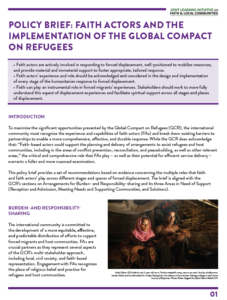
The JLI recently hosted an online event to learn about the Global Compact on Refugees (GCR) adoption directly from UNHCR. JLI Research Director launched our new policy brief on faith actors and the implementation of the GCR. A range of organizations about their reflections on faith and the GCR.

Agenda and quick highlights

Welcome – Jean Duff, JLI Coordinator

Update on the GCR and role of faith actors – Rachel Criswell, NGO and Faith Liaison, UNHCR

  • With increasing numbers of refugees and protracted discplacement worldwide, robust support from the start to bolster areas such as infrastructure, water supply, hospitals, schools, and roads. The Comprehensive Refugee Response Framework (CRRF) was set out in the New York Declaration (NYD) for Refugees and Migrants (Sept 2016), adopted by all 193 Member States of the UN.CRRF forms the basis of the new Global Compact on Refugees (GCR), which operationalize it through a Programme of Action and translate policies into practice. The GCR is based on the experiences in practical application of the CRRF in concrete situations in the field.   The GCR calls for the response to a crisis to supplement humanitarian services with development support for refugee and host communities alike. After two years of consultation, on December 17, member states excluding the US and Hungary ratified the GCR at the UN General Assembly.
  • Good practice case studies, implementation of the CRRF and further information on comprehensive refugee response can be found at http://www.globalcrrf.org

Role of Faith Actors in Implementing the Global Compact – Dr. Olivia Wilkinson, JLI Director of Research (Launch of new JLI policy brief)

  • “Faith-based actors could support the planning and delivery of arrangements to assist refugees and host communities, including in the areas of conflict prevention, reconciliation, and peacebuilding, as well as other relevant areas.”– Global Compact on Refugees, UNHCR
  • Roles of Faith Actors in Arrangements for Burden- and Responsibility-sharing and three Areas in Need of Support (1.Reception and Admission, 2.Meeting Needs and Supporting Communities, 3.Solutions).
  • Faith actors are actively involved in responding to forced displacement, well-positioned to mobilize resources, and provide material and immaterial support to foster appropriate, tailored response.
    • Faith actors’ experience and role should be acknowledged and considered in the design and implementation of every stage of the humanitarian response to forced displacement.
    • Faith can play an instrumental role in forced migrants’ experiences. Stakeholders should work to more fully understand this aspect of displacement experiences and facilitate spiritual support across all stages and places of displacement.
  • See Policy brief funded by the Luce Foundation for case studies and recommondations.

Learning exchange on Faith and GCR

  • Emily Wei, Catholic Relief Services
  • Atallah FitzGibbon, Islamic Relief Worldwide
  • Dr Katherine Marshall, Berkley Center for Religion, Peace, and World Affairs & World Faiths Development Dialogue
    • Presented three initiatives in research and policy in refugee issues
    • Research on critical areas in refugee issues in conflict countires ex. Nigeria
    • Host Country research in Kenya and third country resettlement countries ex. US: Diaspora communities and religion with Pluralism Project
    • Presented a two-year project supported by Georgetown University’s Board of Regents
      • various case studies underway currently for example in the northern triangle countries and reception in the US
      • Need to understand better specific facets of religious approaches, including links to conflicts spurring migration and refugee flows
      • Mapping of purposeful interventions, learning lessons from good and bad practice
      • Need to understand better specific facets of religious approaches, including links to conflicts spurring migration and refugee flows
      • Mapping of purposeful interventions, learning lessons from good and bad practice
      • See Berkley Center refugee site
    • G20 Recommenations
  • Giulia McPherson, Jesuit Refugee Service
    • Presented JRS Advocacy Efforts and
    • Key Messages:
      • Accompany all vulnerable people on the move and to provide for their basic needs.
      • Invest in medium- and long-term development approaches to the humanitarian needs of forcibly displaced persons.
      • Invest in economic and infrastructure growth within host communities.
      • Share the financial burden and other costs among all countries.
  • Christo Greyling, World Vision International
  • Tom Albinson, International Association for Refugees (with Christine Macmillan at World Evangelical Alliance)
    • Presented IAFR Continuum of Reponse. Model to help faith communities understand how to support people in recovery and long-term durable solutions
      • helping people who are displaced or are refugees find support, people recovering from trauma and people who are in new contexts, people who need spiritual support and listening to those displaced to affirm their dignity be a part of the solution

Closing remarks and Wrap Up

Join the JLI Refugee Hub for continued joint learning

Related Resources:

Read the Policy Brief


Accompanying Resource Brief


Presentation PowerPoint

Religion and FBO inputs to the Global Compacts: recent meetings at the UN

A meeting at the UN hosted by the  Permanent Observer Mission of the Holy See to the United Nations and Caritas brought together global religious leaders who called the world to share the journey with migrants and refugees. Watch the full event here


As part of a series of related events UNICEF, NGO Committee on UNICEF and Caritas Internationalis co-organized a side event on Interfaith Responses to the Rights of Refugee and Migrant Children and their Families.


A panel moderated by Ame Esangbedo of SOS Childrens’ Villages, of speakers including representatives from Lutheran World Federation, Islamic Relief, Religions for Peace and JLI discussed key issues from a religious and FBO perspective, including solutions and challenges around addressing the needs of refugee and migrant children and their families with a focus on keeping families together, provision of services and combatting xenophobia.

JLI panel presentation (click for presentation) focused on evidence and ongoing research relating to Faith-based responses to Children’s Rights and Migration.


Other events covered:

Side event at the Asia Pacific Forum for Sustainable Development 2018

Wednesday, 28 March 2018

Organizers: World Vision International (WVI), ACT Alliance, Islamic Relief Worldwide (IRW), Soka Gakkai International (SGI), Arigatou International

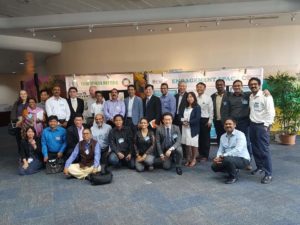
World Vision, ACT Alliance, Islamic Relief, Soka Gakkai International, Arigatou International, global faith based organizations launched the Asia Pacific Faith-based Coalition for sustainable development (APFC) on 28 March in collaboration with Asia Civil Society Partnership on Sustainable Development.

The objective of this coalition is to provide greater impetus to the voices of faith communities and effectively engage in Asia pacific regional development discourse feeding to global processes, such as the SDGs. This is an open, inclusive coalition representing different faiths towards achieving sustainable development and peace.

The forum will support the presentation of voluntary national reviews and will assess the progress made with regard to the regional roadmap for implementing the 2030 Agenda for Sustainable Development in Asia and the Pacific.


Session Moderator

Mr. Norbert Hsu, Regional Leader, East Asia Region, World Vision International (WVI)

Panelists/discussants

  • John Patrick Murray | National Catholic Commission on Migration, Thailand
  • Hiro Sakrai | Director of the Office for UN Affairs, Soka Gakkai International
  • Masud Siddique | Head of Asia Region, Islamic Relief Worldwide
  • Anselmo Lee | Senior Advisor, ADA and APSD
  • Shinji Kubo | Officer – in – Charge, UNHCR Representative in Bangkok, Thailand

The discussion addressed the role of faith in making communities resilient and socially cohesive to achieve sustainable development.

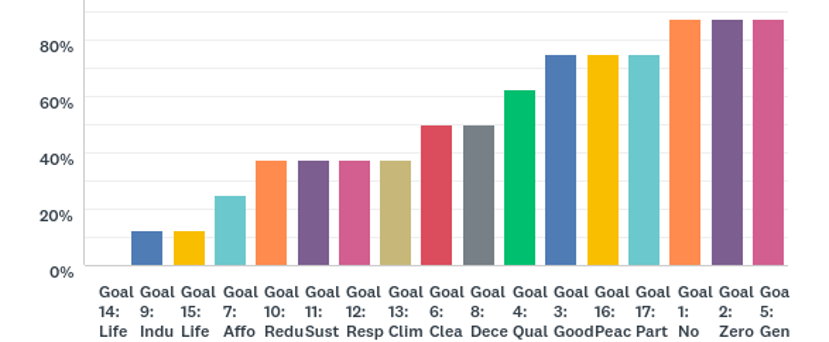
The initial work of the coalition will include mapping faith-based organization (FBO & Faith actor) work in relation to sustainable development in Asia Pacific. Results from their initial survey found that many organizations worked to address SDGs #1, 2, 5 followed by 3, 16 & 17.

*from the introduction ppt presented at the forum by Anoop Sukumaran and Sudarshan Reddy

Read more: Asia Pacific Faith-Based Coalition for Sustainable Development_28 March- Concept Note , World Vision Press Release or APFC launch report

For more information contact Abid Gulzar, Director Advocacy and Justice for Children, World Vision International, (abid_gulzar@wvi.org)