On May 11, 2021, JLI held a webinar where Dr. Namrata Sharma, State University of New York, introduced her new book: Value-Creating Global Citizenship Education for Sustainable Development that caters to formal and non-formal learning. Dr. Wendy Yee Mei Tien, University of Malaya in Malaysia and Fellow at KAICIID, responded followed by a question and answer session.
The COVID-19 pandemic caused crises that have affected different groups and communities in different ways. In the best of times, inequalities between men and women are a major concern, and 2021 has seen related challenges grow, with new ones emerging. These challenges are seen through many lenses (politics, family, education, employment), including a lens of faith. That means narratives that religious communities, in all their diversity, use to describe the phenomena of women’s leadership, burdens of care, challenges to girls’ education, and rising domestic violence. Faith communities worldwide have responded in many cases with energy and compassion to immediate needs, but more thought and action are needed in the months ahead.
This event drew on the Religious Responses to COVID-19 project, which has catalogued and analyzed faith responses to the COVID-19 emergencies. Throughout, the strengths and vulnerabilities of women and girls cried out for attention and action. Looking ahead, this event addressed how religious beliefs have colored and shaped gendered experiences during the crisis, what challenges emerge for interpersonal relationships, and explored what “rebuilding better and fairer” means in practice.
JLI’s CEO, Kirsten Laursen Muth, speaks on faith and gender.
Co-sponsored by the Joint Learning Initiative, World Faiths Development Dialogue, and Georgetown University’s Berkley Center for Religion, Peace, and World Affairs.
On April 8, 2021, JLI held a webinar where Dr. Xavier Moyet, Visiting Fellow at University of Leeds, and Research Associate at University of Kent, presented his paper on Pentocostalism, Public Health, and COVID-19 in Nigeria. Dr. Allo Tolulope, Covenant University, Nigeria, responded, followed by a question and answer session.
The Joint Learning Initiative on Faith and Local Communities and The Faith+Public Integrity Network hosted a Faith and AntiCorruption Webinar on March 22, 2021.
Corruption, particularly endemic corruption, is widely recognized as a key obstacle to development. Anticorruption has been central to the international development agenda for over two decades. Our theme is corruption, a social malaise widely recognized as one of the greatest impediments to equitable and sustainable development. Efforts to counter corruption, at the international and national levels, have been at the center of the development agenda, though the results have not been very encouraging. Engagement of faith leaders and organizations in anticorruption efforts has been too limited.
View the conversation below that explores the opportunities and challenges for faith leaders and organizations in promoting public integrity and fighting corruption.
Topics discussed: Why is it important for faith actors to be involved? How might they be involved? What distinctive assets might they bring? What are some specific examples? Why haven’t we seen more engagement? Will the growing emphasis on collective action foster greater participation of faith actors? Do faith actors themselves need an internal moral awakening or is the limited engagement more linked to uncertainty as to effective strategies and tools?
Speakers:
Katherine Marshall, Berkley Center for Religion, Peace, and World Affairs and World Faiths Development Dialogue
Katherine is a leading expert on the engagement of the faith sector in development. She is a senior fellow at the Berkley Center for Religion, Peace, and World Affairs, and a professor of the practice of development, conflict, and religion in Georgetown University’s Walsh School of Foreign Service. She helped to create and now serves as the executive director of the World Faiths Development Dialogue. She is also vice president of the G20 Interfaith Association. Marshall, who worked at the World Bank from 1971 to 2006, has nearly five decades of experience on a wide range of development issues in Africa, Latin America, East Asia, and the Middle East. She led the World Bank’s faith and ethics initiative between 2000 and 2006.
Roberto Laver, Fides and Faith and Public Integrity Network, FPIN
Roberto is an international lawyer with over thirty years of experience in law and development, nonprofit leadership and academia. He is founder and director of Fides, a nonprofit supporting Christian leaders and communities to promote public integrity and counter corruption. He is cofounder and member of the steering committee for the Faith and Public Integrity Network, a global network of Christian leaders engaged in grassroots anticorruption initiatives. Roberto practiced law in the private sector in Argentina and in Washington D.C. and Boston, USA. From 1989-1998, he worked at the World Bank with a focus on rule of law and judicial reform. He taught at the Fletcher School of Law and Diplomacy and has been a network fellow at Edmond J. Safra Center for Ethics at Harvard University.
On March 11, 2021, JLI held a webinar where Dr. Riham Ahmed Khafagy (Assistant Professor, Department of International Affairs, Zayed University) presented her paper ‘Faith-based Organizations: Humanitarian Mission or Religious Missionary’. In her presentation, Dr. Ahmed Khafagy compared the British Islamic Relief Worldwide (IRW) and the Kuwaiti Direct Aid Society (DAS) to examine the influence of social settings on the humanitarian experiences of Islamic faith-based organisations. A response was provided by Dr. Amjad Mohamed Saleem (Manager for Inclusion, Protection and Engagement at the International Federation of the Red Cross and Red Crescent and JLI Board Member), followed by an engaged discussion with the audience, which included academics, NGO researchers and practitioners.
On February 11, 2021, JLI held a webinar where Dr. Nora Khalaf-Elledge, Associate Lecturer at Goldsmiths, University of London, presented her paper “It’s a tricky one” – development practitioners’ attitudes towards religion. Dr. Aikande Kwayu, Honorary Research Fellow, Department of Anthropology, University of Wisconsin and Development Research Consultant, BUMACO Ltd, Tanzania, responded, followed by a question and answer session.
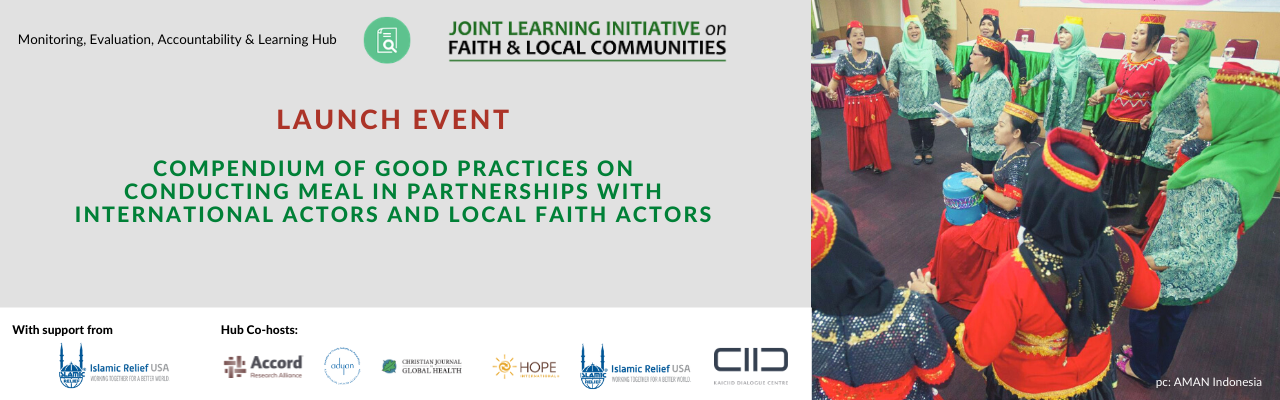
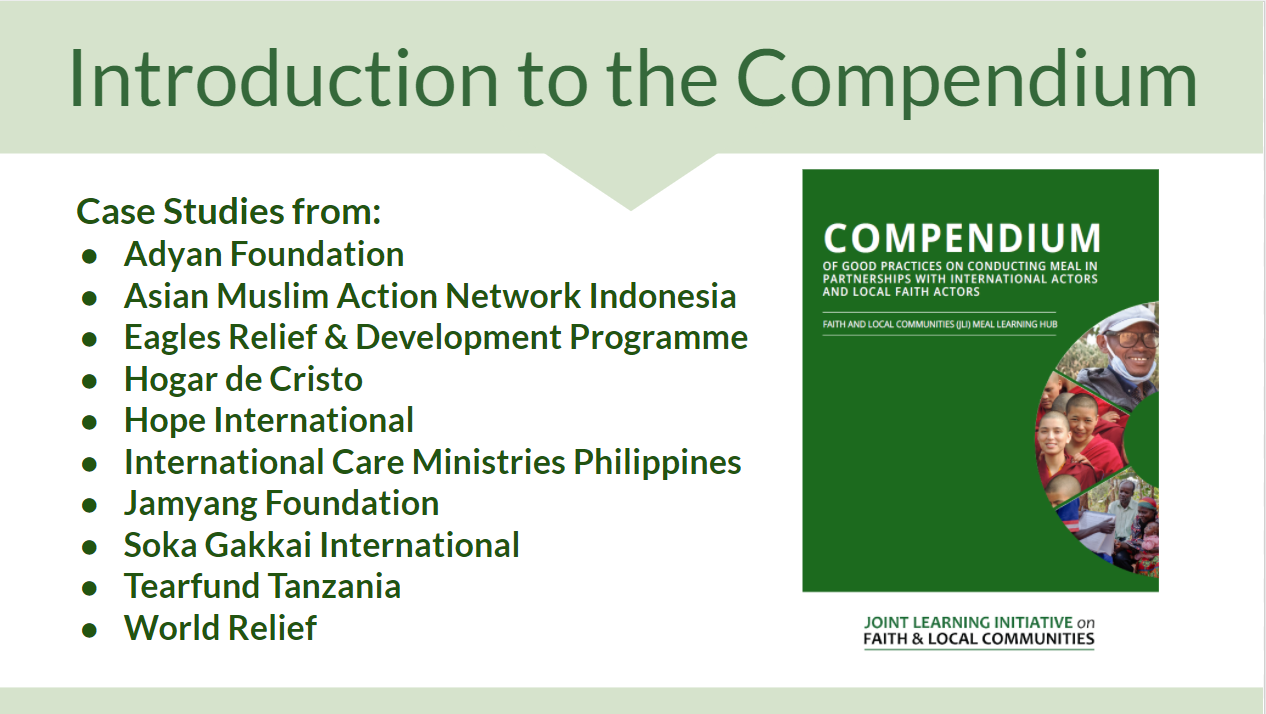
The JLI MEAL Hub launched a new ‘Compendium of Good Practices Conducting MEAL in Partnerships with International Actors and Local Faith Actors’
The Compendium, launched this January, explores good practices of MEAL in partnerships between international actors and local faith actors. It is based on more than 30 interviews with representatives of secular and faith-based international organisations, local faith actors, and academics. It also includes a selection of 10 stories of change that illustrate the diversity of MEAL practices around the world.
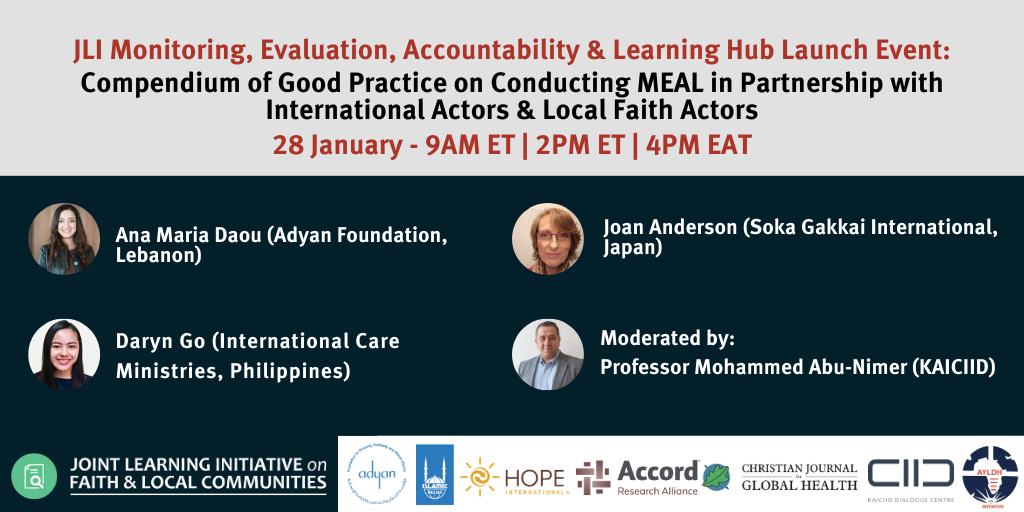
The Compendium was launched in an online panel event that brought together speakers and stories of MEAL from different faith traditions and from across the world. Speakers included:
Dr Jennifer Philippa Eggert (Senior Research Associate, JLI)
Ana Maria Daou (Adyan Foundation, Lebanon)
Daryn Go (International Care Ministries, Philippines)
Joan Anderson (Soka Gakkai International, Japan)
Jessica Baumgardner-Zuzik (Alliance for Peacebuilding, USA)
Hamayoon Sultan (Independent Consultant, UK)
Moderated by Professor Mohammed Abu-Nimer (KAICIID, Austria) with a welcome by Kirsten Laursen Muth (CEO, JLI)
Dr Jennifer Philippa Eggert, lead researcher and author of the Compendium,gave an insight into how it was developed. She spoke of how the research team made concerted efforts to reach out to non-Western organisations, including Muslim, Hindu, Sikh and Buddhist organisations. The contributions and stories of non-Western and non-Christian organisations ultimately helped the Compendium move beyond its original purpose, by not just highlighting examples of good practice within Western frameworks, but also questioning the very need for these in all circumstances. As Dr Eggert concluded, “We hope to move the conversation one step further and really question if the end goal is for everyone to adopt Western-style MEAL, or is there maybe space for something else as well?”
The panellists gave an overview of their own organisational MEAL practices. Ana Maria Daou outlined Adyan Foundation’s methodology using the IMPACT acronym (Information, Measurement, Presentation, Accountability, Challenges, Transfer); Daryn Go spoke of how International Care Ministries used COVID restrictions as an opportunity to do regular phone surveys with local faith leaders, in turn ministering local faith leaders and developing faith-rooted, supportive friendships with them; Joan Anderson talked about Soka Gakkai International’s horizontal structure, which removes the power differential of donor-beneficiary relationships, and instead allows their MEAL approach to focus on monthly local meetings where participants can share feedback or stories of change.
The discussants, Jessica Baumgardner-Zuzik and Hamayoon Sultan endorsed the Compendium’s solutions-based and locally-rooted approach, and shared their own experiences of the power imbalance between international donors and local faith actors.
Attendees were able to participate in an ongoing discussion alongside their event, sharing their own questions, experiences and stories of MEAL in international and faith actor partnerships. Contributions included:
Questions around how to characterise and differentiate “Western” vs. “non-Western” MEAL. Some attendees asked if “Western” MEAL could be characterised as more quantitative analysis, whereas “non-Western” MEAL may be more focussed on storytelling. One attendee questioned if “indigenous MEAL” might be a more useful term.
Discussions around the costliness, complexity and burden of Western MEAL approaches for local actors that lack the resources to implement them.
The need to look at the power dynamic between international and local faith actors, particularly in the context of efforts to decolonise development.
Suggestions and stories of good practice MEAL approaches used by attendee organisations, e.g.: participatory learning approaches, storytelling, behavioural change communication, incorporating MEAL into the project implementation itself, developing MEAL tools in consultation with local faith leaders, feedback loops etc.
The benefits and challenges of storytelling approaches. While storytelling might be tied into a communities’ history and culture, utilising storytelling for MEAL can be challenging. One participant raised their experience of getting informed consent to utilise and analyse excerpts of stories from indigenous elders – who were concerned that their stories may be ascribed unintended meanings.
How to increase Western donors’ trust in MEAL approaches that rely more on stories and beneficiary feedback.
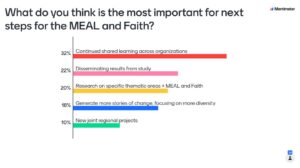
The session closed with a series of Menti survey questions, asking participants:
1. What do you think are the most important next steps for the JLI MEAL and Faith Hub?
2. How can the JLI MEAL Hub collaborate with your organisation on faith and MEAL?
Response to this second question included suggestions for the JLI MEAL Hub to facilitate knowledge and resource sharing, e.g. through sharing of best practice methodologies, case studies and pilot projects, sharing resources between members to avoid duplication of efforts, and facilitating shared learning on specific topics, e.g. through regular virtual events or by producing joint M&E guides on key topics.
Many attendees spoke of their desire for the JLI MEAL Hub to support better connections and relationships, both between Hub members internally e.g. through regular internal meetings, but also externally with other donors and practitioners – for example, providing platforms for members to attend external meetings and share their successful case studies.
Attendees also suggested that the JLI MEAL Hub should support and facilitate research, for example through conducting its own research, facilitating peer reviews between members, and encouraging organisations to submit their research for publication. Attendees also recommended the JLI MEAL Hub develop capacity-building opportunities for individuals working in the arena of MEAL and faith.
The JLI MEAL Hub hopes for this Compendium to be a practical and transformative resource for anyone interested in, or working in, the areas of MEAL and faith – whether international donors, secular or faith-based development organisations or local faith partners.
For more information, download the Compendiumhere, or sign up to the JLI MEAL Hubhere
Read the press release for the Compendium launch here
The books editors, Ajaz Ahmed Khan, Senior Microfinance Adviser at CARE International, and Affan Cheema, Head of Programme Quality for Islamic Relief Worldwide, introduced the book. Chapter Author, Dr. Sylvia Brown, Conflict Advisor at Islamic Relief, also spoke. Q&A and discussion followed the presentations.
Click here to find a blog post from the book’s editors.
Click here to register and view the list of upcoming webinars.
On December 10, 2020, JLI held a webinar where Dr.Aikande Kwayu, Honorary Research Fellow, Department of Anthropology, University of Wisconsin and Development Research Consultant, BUMACO Ltd, Tanzania, presented her book “Religion and British International Development Policy”, which includes discussion on the implications of Brexit for FBOs. Dr. Sabine Dreher, University of York, Canada, responded followed by a question and answer session.
On November 12, 2020, JLI held a webinar where Ela Drazkiewicz, Slovak Academy of Sciences, Institute of Sociology, presented a chapter from her book on “The Moral Economy of Foreign Aid: Religion and Institutions”. Prof. Emma Tomalin, University of Leeds, responded and a discussion followed.
Click here to register and view the list of upcoming webinars