
Anglican Alliance launches global focus on anti-slavery initiatives in Freedom Year
The Anglican Alliance has produced a Freedom Year booklet to help people engage with the fight against modern slavery and human trafficking in 2018.
Photo Credit: Anglican Alliance

The Anglican Alliance, which helps to coordinates Anglican churches and agencies to work for a world free of poverty and injustice, has launched a year-long focus on anti-slavery initiatives across the Communion. Through its Freedom Year initiative, the Alliance is inviting people to learn more about human trafficking and modern slavery in the world today, pray for change, and take action to end it. A Freedom Year booklet, which will soon be available in Portuguese, Spanish and French, contains monthly themes and activities to “help us to take action, and encourage us join the fight against human trafficking and modern slavery, both locally and globally,” the Alliance says.

The booklet also contains prayer points to underpin the project, and the activities build up to what the Alliance hopes will be “a month of focused prayer and advocacy in July”, which they are calling Freedom Month, culminating in the International Day against Trafficking in Persons on 30 July.

“We hope that this year you will be encouraged to connect with people around the world, to learn from each other, and to recognise the crucial role that churches play in the fight against human trafficking,” the Alliance says.

The initiative is based on “Seven Ps”: Prayer, Prevention, Protection, Prosecution, Partnership, Policy and Participation.

Human trafficking and modern slavery is an international crime being carried out on an immense scale. Last September, a report by the UN’s International Labour Organisation (ILO) revealed that more than 40.3 million people across the world were victims of modern slavery in 2016 – and 71 per cent of them were female and a quarter were children.

The figures also showed that almost 25 million people across the world were trafficked for labour. More than 15 million people were in forced marriages and almost five million people were victims of forced sexual exploitation.

In a video marking the launch of Freedom Year, the Revd Rachel Carnegie, co-executive director of the Anglican Alliance, said: “We invite you to join us on a journey – a journey together when churches around the Communion will work together to tackle the terrible crime of modern slavery.

“Individually it is very hard to do something, but together, and in this Freedom Year, we really pray to God that we can make a difference.”

Resolutions calling for action on human trafficking were passed by the Anglican Consultative Council at their last meeting in Lusaka in April 2016; and last October, at the Primates’ Meeting in Canterbury, Anglican leaderfs described human trafficking as “a crime against humanity which profits from the exploitation and abuse of vulnerable individuals.”

The primates committed themselves “to address this issue in our countries and across the globe.”

The Anglican Alliance is working ecumenically to help co-ordinate action on human trafficking and modern slavery; and works particularly closely with the Salvation Army and Caritas – the Roman Catholic Church’s international development charity. And throughout the world, Anglican provinces are working to tackle the issue in their localities.

Initiatives include a dedicated date in the lectionary of the Anglican Church of Melanesia, an ecumenical initiative to tackle the problem in Kenya, regional consultations with a view to establishing a country- wide programme in Canada, and the Church of England’s Clewer Initiative, which is helping dioceses and wider church networks to develop strategies for detecting modern slavery in their communities and help provide victim support and care.

For more information see the Freedom Year Website

Follow on Facebookand Twitter, using the hashtag #ChurchesAgainstTrafficking
Localizing Response to Humanitarian Need: The Role of Religious and Faith-Based Organizations

October 16-19, 2017

Colombo, Sri Lanka

Faith leaders, aid agencies around the world join forum on localizing humanitarian response

JLI cohosted the Localizing Response to Humanitarian Need Forum with over 140 participants representing multiple local and global faith networks, faith-based organizations, aid agencies, policy makers, and government representatives have participated in a forum to strengthen partnership and networks in localizing humanitarian responseFocus on documentation of methods and mechanisms of engagement of local faith networks.

Working Areas:

  • Children & Health
  • Conflict & Peacemaking
  • Disaster response
  • Disaster risk reduction and resilience
  • Refugees & Forced Migration
  • Gender-based Violence

BRIEF SUMMARY REPORT


On October 20, the new JLI Anti-Human Trafficking and Modern Slavery Hub launched at the Anglican Alliance. Gathering a group of core members, the hub discussed the terms of reference and key questions the hub would address. The group focused on areas related to prevention, protection, prosecution, policy, partnerships and participation.

The purpose of this Hub is to be a horizontal learning community and global resource that links academics, policy makers and practitioners working on issues of faith, faith leaders and religious communities to combat human trafficking and modern slavery. The goals are to:

  • Identify and examine what we know about human trafficking, with respect to the role of faith based actors and religious and cultural values, and the reliability of this research. Work out how we can better communicate existing research.
  • Identify gaps in knowledge which can be addressed through further research and learning (with an emphasis on practical application afterwards).
  • Arrive at practical actionable recommendations in these areas (for programmes and policy) that JLI members would be encouraged to implement in their own organisations, use to potentially influence the practice of others, and which could increase effective partnerships/collaboration between members of the Hub (secular and faith based) in ending human trafficking and modern slavery.

October Events

October 3:  JLI Joint Learning Webinar on Local Humanitarian Leadership with Oxfam America

October 11-12:  WCC Workshop on mapping Christian health services

October 9-13: One Accord Forum and Expo

October 11-13: Alliance for Peacebuilding’s Annual Conference: Peace Now More than Ever

October 14: Boston University Going Viral: Religion and Health

October 16-19Localising Response to Humanitarian Need

October 26: Faith and feminism working group The impact of fundamentalism and extremism on the cultural rights of women: time to take a stand

October 30: UN Strategic Learning Exchange & Skills Building Workshop: Religion, Gender and Youth Inclusion in Peace & Security

October 31: 2017 Annual International Conference on Ethnic and Religious Conflict Resolution and Peacebuilding


November

Nov 9: Interfaith Symposium Countering Fear & Rise in Discrimination UK

Nov 10: JLI SGBV Hub Study Dissemination

Nov 12-15: PaRD annual meeting (London)

Nov 15: DFID/ UKAid conference “Current challenges in Freedom of Religion or Belief

Nov 16-18: Vatican: Addressing Global Health Inequalities

Nov 21UN Staff Strategic Learning Exchange- Engaging with Faith Organizations and communities

Nov 26: Faith-based organizations’ contribution to Sendai Framework for Disaster Risk Reduction

JLI Joint Learning Opportunity: Webinar on Local Humanitarian Leadership – hosted by the JLI Refugee Hub and Mobilisation of Local Faith Communities Hub

October 3 

Local Humanitarian Leadership and Faith
Guest Presenter: Tara Gingerich – Oxfam America

Moderator: Catriona DejeanTearfund (JLI Mobilisation of Local Faith Communities Learning Hub co-chair)

Local humanitarian leadership is built upon the premise that humanitarian action should be led by local humanitarian actors whenever possible, yet this research finds that secular humanitarian INGOs do not engage systematically with local faith actors in their local leadership work. Based primarily on interviews with humanitarian INGO staff, this research also found that neither secular nor faith-inspired international humanitarian organizations have a sufficient level of religious literacy to enable them to understand the religious dimensions of the contexts in which they work and to effectively navigate their engagement with local faith actors.

Webinar included the following discussion on local humanitarian leadership and religious literacy.

Response from Catriona Dejean
  • Faith-inspired vs faith- embedded organizations – for some FBOs faith is at the DNA of who and how they work, so it is beyond inspiration
  • Role of relationships: trust between local faith communities and secular organizations are critical especially during humanitarian events (ie good examples in Myanmar, Middle East)
  • It is important to not only look at the structures, processes and tools for engaging with faith communties, but also to understand what enables good and open relationships.
  • Attitudes and behaviors on engagement across faiths and non-faith groups could be explored further.
  • What makes a response effective with local faith communities? The report stated no real difference between secular and faith actors. Could it be because we have different definitions of effective? For example some faith organizations and actors are interested in holistic changes so effectiveness may be framed beyond the tangible or traditional definition of effectiveness.
From other attendees:
  • Role of faith-based organizations as intermediaries
  • There seems to be some dissonance between the responses reported in the research (from HQ) and the situation on the ground, where FBOs face a lot of pressure. There might be an openness to the recommendations stemming from the research such as designing a religious literacy toolkit, but there will need to be a true dialogue on a practitioner level and real socialization.
  • Suggestions for secular organizations seeking to discuss topics with faith-based actors for which they have different understandings. How can these conversations happen most productively? Practicality of engaging with local faith actors
    • On alignment (or not) with local faith groups and how to deal with issues – the Oxfam recommendation to develop tools to help truly assess religion/culture/historical influences on the target group in a humanitarian response is vital. That should help tease out more clearly what the actual or perceived differences are. Ultimately though, as was said, if a local faith community (or any partner of any kind) isn’t able to or doesn’t desire to ‘align’ with humanitarian principles – INGOs needs to decide whether the partnership can continue. We have to deal with our issues too of course!
    • If the whole community believes in one specific religion, it’s simple, but if it’s divided into some religious groups, it can become sensitive. The literacy should cover this aspect as well.
  • About LFAs impartiality, neutrality,& proselytising: how often does this happen vs how often do people on the international level worry about this occuring?
  • Forthcoming article called ‘“Faith can come in, but not religion.” Secularity and its effects on the disaster response to Typhoon Haiyan.’ that deals with impartiality and some of the hypocrisy.
  • See Katie Kraft’s article in the ICRC journal on impartiality and proselytization.
  • The basic idea is that religion manifests in Faith-based NGOs in different ways, such as their names, missions, activities, goals, modes of expression, membership or employment criteria, institutional origins, or the identity of populations they serve, and invisibility is their greatest asset. That is, Faith-based NGOs are most effective in private coalitions and when they do not engage in explicitly religious terms.
  • See also American Academy of Religions recent book: Religion, NGOs and the UN
  • Important to dig into ‘instrumentalism’
  • The JLI Refugee hub will be releasing it’s first scoping study on Urban Displacement, Refugees & Forced Migration and the Role of Faith Actors soon.
  • The Mobilisation of Local Faith Communities Hub will have a webinar coming up in December
  • On Oct 16-19, a relevant conference co-hosted by the JLI will occur in Sri Lanka on Localizing the response to Humanitarian Need: The Role of Religious and Faith-based organizations
    see lrf2017.org


September 18, 2017

at Moral Imperative UNGA Meeting

Location: WCC Church Center

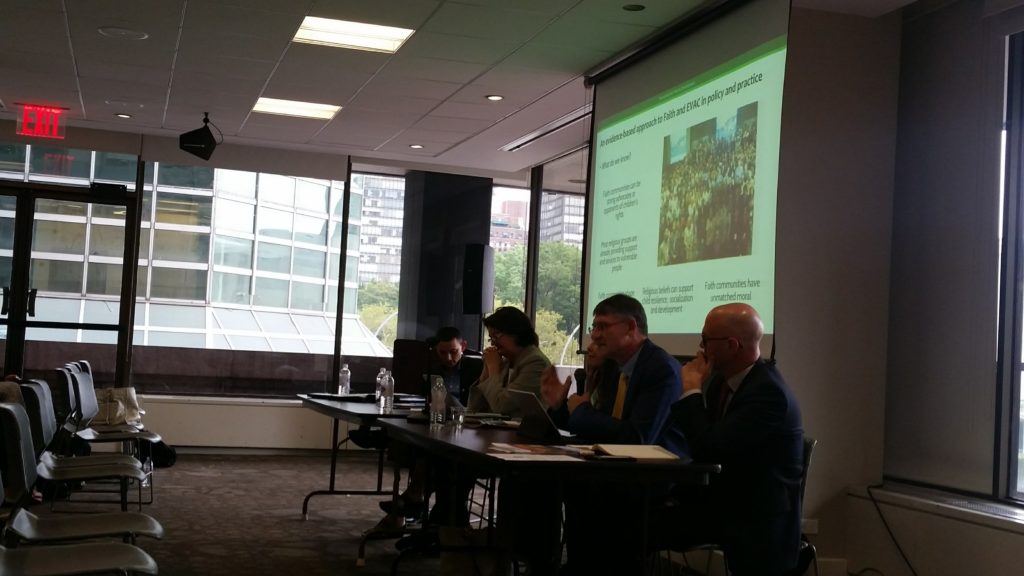
Launch of the Ending Violence Against Children Hub

Hosted by the JLI Ending Violence Against Children Learning Hub with co-chair organizations: Arigatou International and World Vision International

The meeting introduced the JLI EVAC Hub, discussed roles of faith communities and actors in  Ending Violence Against Children (EVAC).

Panel included:

  • JLI EVAC Core Members: Gerry Dyer  representing the Global Partnership on VAC and Rabbi Diana Gerson, NY Board of Rabbis
  • Adam Taylor, Moral Imperative
  • Jean Duff, JLI Coordinator
  • JLI EVAC Hub Representatives: Christo Greyling, World Vision International and Rebeca Rios-Kohn, Arigatou International

The convening co-chairs of the JLI Learning Hub on Ending Violence Against Children (EVAC Hub) are:

  • Robyn Hagan, World Vision International, Global Advisor – Faith Partnerships for Child Protection
  • Rebeca Rios-Kohn, Arigatou International New York Office, Director
  • Carola Eyber, Queen Margaret University, Institute for Global Health and Development, Senior Lecturer

Following the launch the JLI Ending Violence Against Children (EVAC) Learning Hub met together at the Salvation Army ISJC with academics, policy experts, and practitioners to review and analyse the knowledge base regarding the multiple roles of faith and faith actors to influence or end violence against children, in line with SDG 16.2. The Ending Violence Against Children Hub is a part of the Joint Learning Initiative on Faith & Local Communities Learning Hubs. For a meeting summary please join the hub here


The International Dialogue Centre (KAICIID) is seeking applications from education professionals that train future religious leaders to take part in the 2018 KAICIID International Fellows Programme. The Programme gathers religious teachers from around the world for in-person and online training in dialogue, mediation and promoting social cohesion that will bring the Fellows to Vienna to teach dialogue, become active facilitators and leaders in dialogue and be advocates for peace in their communities.

Set to commence in January 2018, the International Fellows Programme will support the Fellows development so they can develop and implement small-scale local and international projects during the course of the programme. There will also be opportunities to organize and attend dialogues, lectures, field visits and conferences


The deadline for applications is 31 July 2017.

Apply on their website

July 12, 2017

Convened by the Permanent Mission of Ireland to the United Nations and the UN Interagency Task Force on Religion and Development (Chaired by UNFPA) in partnership with the Joint Learning Initiative on Faith and Local Communities.

HE Ambassador David Donoghue, Permanent Mission of Ireland to the United Nations, and Dr Azza Karam, UN Interagency Task Force on Religion and Development will be co-moderating.

Jean Duff will be representing JLI on a panel addressing faith-based partnerships to support achievement of the Sustainable Development Goals (SDGs). The panel will also include JLI Board Member Anwar Khan, Islamic Relief USA.

Click below for more details:

Ahimsa – Global Health, Social Entrepreneurship and Faith- inspired Communities

International meeting on Global Health, Social Entrepreneurship and Faith Inspired Communities hosted by Ahimsa in Annecy France
The goals of the Ahimsa Forum conferences are to instigate change and implement innovative global health projects that are accessible to the poor and to create an international network of communities.
JLI represented by Jean Duff. Jean spoke in the first session on Health for All and distinct assets faith communities offer.
Satellite Session on June 30

Engagement Of Faith-Inspired Communities In Local And National Health System Governance 

Objectives of the session

Engage a discussion with and among faith-inspired communities and faith-based organizations on the governance capacities and the changing roles of ministries of health in the 21st Century.

The session will seek to respond to the following questions:

  1. How do faith-based organizations see the role of the ministry of health in the country: what do they expect from the ministry of health and are these expectations fulfilled? Why?
  1. How do faith-based organizations position themselves with regard the ministry of health in the country? What are the opportunities for collaboration and dialogue and what are the challenges?
  1. How can faith-based organizations best play their role in health systems governance? Should they use their position to voice specific concerns? What obstacles do they face in this action?

Chairs: 

  • Maryam Bigdeli, Health System Adviser at the Department of Health System Governance and Financing at WHO
  • Gerard Schmets, Coordinator of the Health Systems Governance, Policies and Aid Effectiveness Unit at WHO

June 14-16th

This year’s Annual Consultations with NGOs focused on continued development of the Comprehensive Refugee Response Framework. The CRRF calls for greater support to refugees and the countries that host them by involving multiple agencies and partners working in a joined up way to facilitate acceptance, protection, integration and where possible and appropriate resettlement or return.

Various speeches and discussions referenced the role of faith leaders and communities as agents to enable refugees to become included in society and build new lives as well as receiving acceptance by host communities.  However questions still remain as to how this would be facilitated or case studies of where it had been utilized in practice in the Global South.

JLI Member Atallah Fitzgibbon, Islamic Relief Worldwide & a representative from WCC spoke alongside social media spokespeople at a side event on xenophobia about the role of faith leaders in providing leadership in tackling xenophobia.  Yasmina Filali from the Orient-Occident Foundation in Morocco also talked about the role of cultural encounters as a way of breaking down barriers and prejudice.

See UNHCR Website for