Realize: Gender Equity and Diversity for Social and Behavioral Change

Event Details

Date: Tuesday, March 28, 2017 (all day) to Friday, March 31, 2017 (half day)
Location: Washington, DC

The TOPS Program and CARE International are pleased to announce an expanded Gender Equity and Diversity for Social and Behavioral Change capacity building workshop. This highly participatory workshop includes material from the previous workshop plus additional new content.  The workshop will increase your own understanding of gender equity and diversity and help you to promote lasting change with your teams and in partnership with communities.

This workshop ends at 1 pm EST on Friday, March 31.

Registration is now open. Apply to attend here. 

World Vision Ebola Evaluations Health Webinar Follow up


An Exploratory Study to Examine the Effectiveness of Community Based Ebola Virus Disease Prevention and Management Strategies in Bo District Sierra Leone

 The unprecedented Ebola Virus Disease outbreak in West Africa was first reported in Sierra Leone in March 2014 and rapidly spread, revealing the failures of the region’s chronically fractured and under-resourced healthcare system. By March 2016, the WHO had documented a total of 14,124 cases of Ebola, including 3,955 deaths, in Sierra Leone – more than any other country. World Vision was actively engaged in implementing preventive activities and case management in 25 of its Area Development Programs, which included 25 Chiefdoms in Bo, Bonthe, Pujehun, and Kono in Sierra Leone. Its Ebola response strategy was designed to work in close collaboration with the Government of Sierra Leone to reach a population of 1.6 million through the establishment and mobilization of an extensive network of community providers established, including teachers, paramount chiefs, and faith healers, over a twenty-year period. A review of district level EVD records indicated that not a single Ebola-related fatality was documented among the 59,000 sponsored children or family members supported by World Vision during the outbreak.  Although the Ebola outbreak was successfully contained, the processes were not formally documented nor the impact of impact of World Vision’s effort was not formally documented or assessed.  The remainder of this report is based on findings from a study commissioned to bridge this knowledge-to-practice gap by capturing community members’ perceptions of the effectiveness of specific strategies employed by World Vision in order to increase the evidence of what works in responding to similar outbreaks throughout the West Africa and beyond.    This report is a collaboration between World Vision and Johns Hopkins Bloomberg School of Public Health.  Read the Summary Report  or

FULL REPORT.


Protecting the Living - Honouring the Dead

The purpose of this study is to assess the barriers and enablers to community acceptance and implementation of safe burials in Sierra Leone. The Ebola virus continued to spread in Sierra Leone partly because communities were initially resistant to Burial Teams carrying out safe, medical burials. This changed towards the end of 2014 when revised burial procedures were published and renamed the Safe and Dignified Burial Protocol. Confrontations with communities decreased and more requests by communities for the Burial Teams were noted. The SMART Consortium, consisting of Catholic Relief Service (CRS), Catholic Agency for Overseas Development (CAFOD) and World Vision as the lead, took over the responsibility for burials in 10 districts across Sierra Leone in November 2014. The Consortium initiated this study to analyse the contribution made by the revised procedures to increased community acceptance of Safe Burials and if there were other factors at play. The results of this study are expected to be used by national and international stakeholders to better respond to future epidemics in Sierra Leone and elsewhere. Read the FULL REPORT. 


Other Webinars

  • 24 March – World TB Day Discussions.  WHO Medical Officer, Dr. Kefas Samson, presents an overview to Childhood TB Response Strategy and World Vision Somalia will present their TB Programme overview, best practice and lessons learned.
  • 4 April – Mother-Led MUAC Screening.  Involving mothers in nutrition screening activities recognizes the fact that they are best placed to identify early signs of malnutrition and reinforces their role in protecting and promoting their child’s health. World Vision piloted this approach in Mauritania as part of an Emergency Nutrition and WASH program. This was the first time the approach had been used in Mauritania.

Details for these webinars can be found at: http://wvi.org/hiv-and-infectious-diseases/global-health-community-practice-webinars
Forum “Sins Before Our Eyes” on Modern Slavery, co-organized by the Ecumenical Patriarchate and the Church of England in Istanbul from February 6-7, 2017.

The aim of the gathering was to bring together distinguished scholars, practitioners, and policymakers from around the world to discuss modern slavery and emphasize the protection of human dignity and freedom as of vital importance for the Church as well as worldwide religious and human-rights communities.

Read more at WCC and Anglican Alliance

Modern Slavery – A Joint Declaration

Archbishop of Canterbury’s speech at Istanbul forum on modern slavery

The Role of Religion and Faith-Based Organizations in International Affairs

Just, Inclusive and Sustainable Peace

On Monday, 23 January 2017 at the United Nations Secretariat the General Board of Church and Society of The United Methodist Church, General Conference of Seventh-Day Adventists and the World Council of Churches (WCC) organized the third annual Symposium.

The United Nations Office on Genocide Prevention and the Responsibility to Protect, United Nations Inter-Agency Task Force for Engagement with Faith-based Organizations and The Committee of Religious NGOs at the United Nations co-sponsored the event.

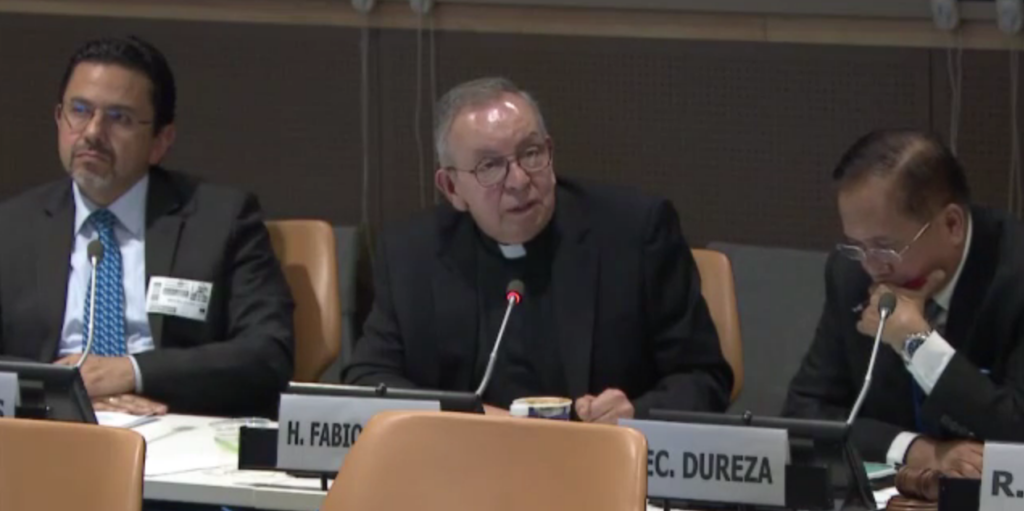
Panel on Current Status of Peace: Philippines and Colombia-Panelists included Dr. Miguel Ceballos Arévalo (left) and Monsignor Hector Fabio Henao and Secretary Jesus Dureza (right)

News article from WCC

Full Symposium Program

Full video of the symposium


Morning Session Summary-Anatomy and Scope of Peace Panel and Religions and Peace Panel

Mr. Rudelmar de Faria opened the morning session. Mr. Adama Dieng also gave a welcome message by video, quoting Secretary General Gutteres that conflict prevention is not a priority but the priority in managing conflict and sustaining peace. He emphasized better integration, provide support, need to work with FBOs and announced the Plan of Action on the role of religious leaders and actions in prevention of atrocities and violence will be released this year.

Rev. Dr. Susan Henry-Crowe followed speaking on how the bible makes justice the inseparable companion of peace and discussed the interrelatedness of the values woven into the UN pillars.

Anatomy and Scope of Peace Panel

Moderated by Dr Azza Karam, Senior Advisor on Culture, UNFPA and Coordinator, UN Inter-Agency Task Force for Engagement with Faith-based Organizations

Dr. Ganoune Diop spoke on a global vision of peace as an enduring value. He spoke about deconstructing nationalist ideologies, need for partnership and collaboration for peace.

H.E. Mr. Pekka Metso said that we could not deny the role of religion in shaping the world of foreign policy. He emphasized the need for mediation mentioning the Group of Friends of Mediation and that women were the single under-utilized resource in effective peacebuilding.

Ms. Joyce S. Dubensky introduced the Tanenbaum Center for Interreligious Understanding highlighting the Peacemakers in Action Network.


Religions and Peace Panel

Moderated by Dr Azza Karam

Mr. Akinremi Bolaji spoke on the reconciliatory role of religious organizations.

Ms. Aisha H.L. al-Adawiya discussed the transmission of trauma and healing and emphasized the need to change vocabulary and media framing of words so as not to create marginalized people.

Mr. Mohamed Elsanousi emphasized four key issues for engaging religious actors- ownership of process, partnership, inclusivity and patience in the process.

Prof. Mohammed Abu-Nimer introduced the KAICIID Centre programs including religious literacy training. He gave two key challenges on working with religious institutions as how do we immunize the public to prevent easy manipulation of religion and how do we bring constructive voices of religion into policy.

Mr. Ulrich Nitschke presented on the International Partnership on Religion & Sustainable Development (PaRD) and its work streams.

Afternoon Session- Just and Sustainable Peace and Panel on Current Status of Peace: Philippines and Colombia

Moderated by Rev. Liberato Bautista, Assistant General Secretary–UN and International Affairs & Main UN Representative, General Board of Church and Society of The United Methodist Church, and President, Committee of Religious NGOs at the United Nations

Mr. Thomas Gass spoke on the SDGs as a framework for peace, duty bearers, rights holders, who we leave behind, reducing inequality and inclusivity.

Mr. Andrew Tomlinson discussed accompaniment, especially locally and a guidebook on Pathfinders for Peaceful, Just and Inclusive Societies based on the SDGs.

Mr. Rudelmar Bueno de Faria gave a presentation on the WCC’s Ecumenical Framework for Peace (click link for presentation).

Dr. Jeffrey Haynes presented the political considerations in peace and the role of FBOs (click link for presentation).

Panel on Current Status of Peace: Philippines and Colombia

Moderated by Rev. Liberato Bautista who remarked that at the table of Peace shall be bread and justice.

Secretary Jesus Dureza and Rev. Rex R.B. Reyes, Jr. introduced a case study on the Philippines peace process.

Dr. Miguel Ceballos Arévalo and Monsignor Hector Fabio Henao presented a case study from Colombia.

H.E. Geir O. Pedersen discussed the Norwegian role in facilitating peace processes.


Four recent Global Interfaith WASH Alliance (GIWA) events promoting use of toilets and clean water-
In Varanasi on the sacred day of the full moon of the month of Kartik, on probably the biggest annual holiday there, GIWA organized a massive event with over 200,000 people. They brought together some of India’s most famous musicians, the interfaith GIWA leaders as well as a delegation of the American Jewish Committee (AJC) that was with us, led by Rabbi Rosen.  They decorated with “Swachhta Kranti” (Clean Revolution) flags (the logo of which is an Indian style toilet!!).  Pujya Swamiji led all the faith leaders, musicians and the whole audience in a massive pledge for WASH, extracting 200,000 promises against open defecation, pollution of ground, air, water etc. This massive annual religious holiday became an opportunity to catalyze awareness and hopefully change in attitude and behavior.
“The sheer beautiful irony of flags with toilets on them being waved while people prayed and sang on the banks of Ganga was amazing.”
-Sadhvi Bhagawati Saraswati
In Rishikesh, GIWA hosted an interfaith event with the AJC, International Buddhist Confederation, International Islamic Sufi Foundation, many of India’s renowned religious leaders and many others again on the theme of WASH and general environmental protection/preservation, particularly of our water bodies. For more information click here-
East Meets West at Major Interfaith Gathering at Parmarth

East Meets West at Major Interfaith Gathering at Parmarth

The day before Mumbai’s first global citizen festival,  GIWA hosted a Roundtable on Water, Sanitation & Hygiene (WASH) for All, organised with the technical support of UNICEF India with interfaith leaders, media leaders and corporate leaders. For further notes on the meeting please see their facebook page.
Additionally on November 13, 2016, Pujya Chidanand Saraswatiji – Muniji joined a beautiful display of interfaith harmony at the famous Ajmer Sharif Shrine- Dargah Shariff of Hazrat Khwaja Muinuddin Chisty during the 33rd General Session of the Jamiat Ulama I Hindi. Some 2 lakh people from Muslim Communities across India and around the world gathered together to hear messages of universal peace and love for all humanity with more than 100,000 in attendance. Click here for more information

The Mobilization of Local Faith Communities (LFCs), formerly Capacity Building, Learning Hub will hold an in-person meeting to reenergize the Hubs work on capturing evidence for activity and outcome of capacity building for LFCs on December 8 and 9th at Trinity College Dublin.

The focus will be on evidence for impact of local faith and community mobilization on aspects of community wellbeing. Our conversation will be informed by the outputs from the upcoming conference at Yale on What Works: Evidence for on the role of Faith in Poverty Reduction


Our Goals:

  • Increase understanding of the role, capacities, activities and contributions of LFCs to community development and humanitarian needs
  • Strengthen empowerment of LFCs as agents of change through increased capacities, resources, and
  • Position LFCs for opportunities relating to trend towards “localization of aid”
Please see draft meeting agenda for more information
Schedule: 
Dec 7th- 6-7:30pm, Irish School of Ecumenics, Trinity College Dublin: Public lecture “Faith, Secularism and Humanitarian Engagement” Alastair Ager, QMU and Columbia University (optional)
Dec 8th- 9am-5 pm: Learning Hub meeting
12.30-1.30 Lunch break and tour of the Book of Kells
5.30- 7.30 pm drinks and supper
Dec 9th- 9am-12.30 pm Learning Hub Meeting

Hotel Accomodations


Please RSVP to stacynam@jliflc.com

The World Council of Churches, the United Methodist Church and the Seventh-day Adventist Church will organize the Third Annual Symposium on the Role of Religion and Faith-Based Organizations in International Affairs, in partnership with the United Nations Office on Genocide Prevention and the Responsibility to Protect, the United Nations Inter-Agency Task Force for Engagement with Faith-based Organizations and the Committee of Religious NGOs at the United Nations on January 23, 2017.

Thematic Focus: Just, Inclusive and Sustainable Peace

Venue: United Nations Secretariat — Conference Room 11

Time: 9:00 am to 5:30 pm, followed by a reception

For more information please see the Concept Note and the Symposium Program

RSVP Here

The International Dialogue Centre (KAICIID) and African Union Commission through the Citizens and Diaspora Directorate (CIDO) organized the 2nd Interfaith Dialogue Forum on 10 to 11 November 2016 in Abuja, Nigeria. The delegates approved a Declaration and a Plan of Action on their joint work in education, partnerships, media and development.

The Declaration acknowledges the need to build partnerships between the African Union, interfaith, faith-based groups, organisations and religious leaders and reiterates their commitment to play an effective role in the successful implementation of the African Aspirations outlined in the Continental Agenda 2063 framework.

As part of the Action Plan, the African Union will support the Steering Committee to establish a 10 year interfaith development agenda for all African Union member states.

For more information see KAICIID website

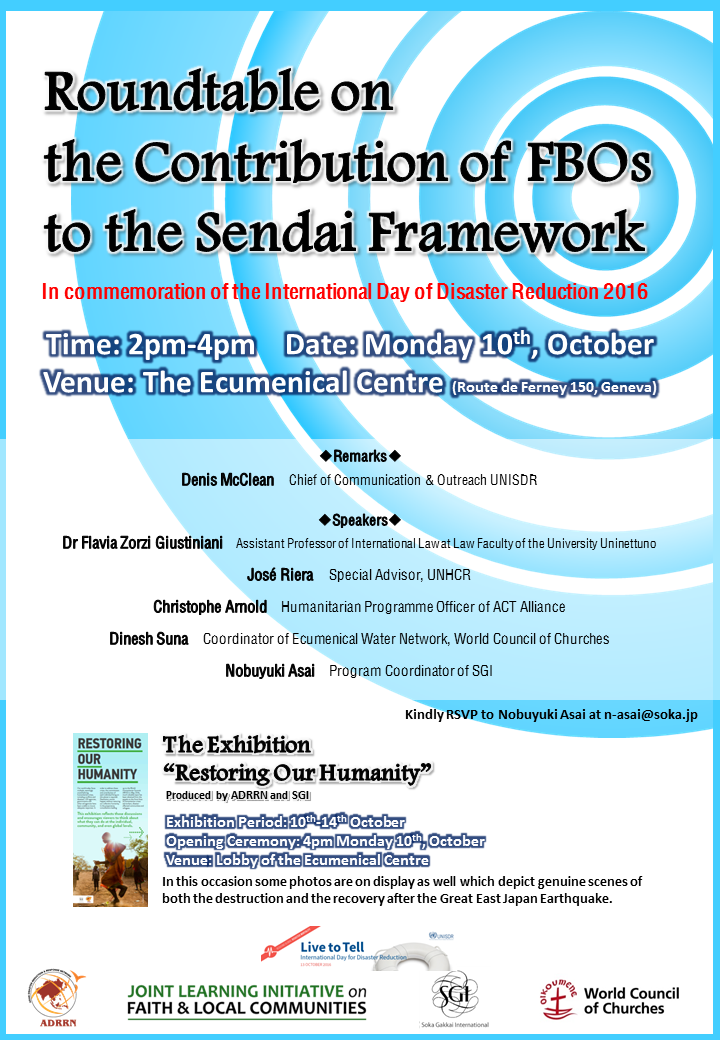
On October 10, JLI partnered with Soka Gakkai International, the World Council of Churches, ADRRN to discuss Faith-Based Organization’s contributions to the Sendai Framework and disaster relief reduction (DRR). The discussion at the Ecumenical Centre in Geneva, Switzerland included the presence of UNISDR and UNHCR.

Summary Report

Topics:

  • Faith groups’ roles in implementing Sendai Framework DRR, in particular, reducing mortality
  • Good practices on DRR conducted by faith groups
  • How to strengthen partnership among governments, UN agencies, FBOs and religious communities
  • Program note
  • UNISDR’s Sendai Campaign 
20160914_flyer_geneva_roundtable

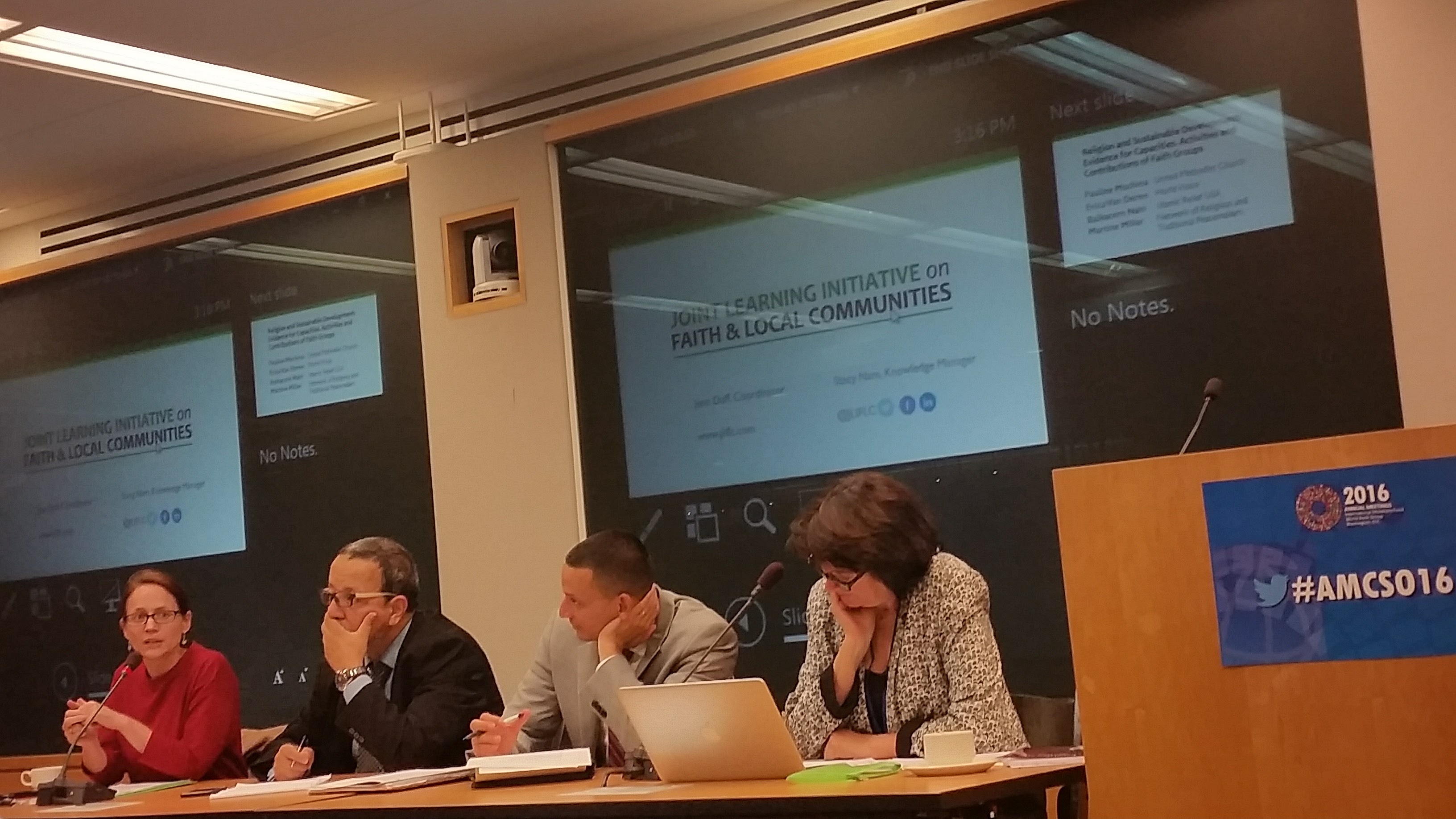
JLI with the World Bank Faith Initiative co-organized  a panel on Religion and Sustainable Development Evidence for the Capacities, Activities and Contributions of Faith Groups towards achieving the SDGs.

The event including World Bank employees and representatives from faith-based organizations.The panel included:


WB CSO 10-16

See here for more details on the event


KEEPING THE FAITH IN DEVELOPMENT: GENDER, RELIGIONS & HEALTH

Tuesday, September 20th – 12:00 – 2:00 pm

Salvation Army Auditorium, 221 East 52nd St (between 2nd and 3rd Ave), New York

UNAIDS, UNFPA, UNWomen (as part of the United Nations Inter-Agency Task Force on Religion and Development), the World Council of Churches – Ecumenical Advocacy Alliance, the Wijngaards Institute for Catholic Research & Islamic Relief USA will co-host a Symposium to launch 3 reports examining the intersections and areas of contention between health, human rights & lived theology (GBV Hub Resource Page)

As a side-event of the UN General Assembly, “Keeping the Faith in Development” will explore areas of conflict and the “faith-full” ways to resolve them, with participants invited to put forward recommendations for action to help achieve the UN Sustainable Development Goals. 

The panel will be comprised of authors, religious scholars, faith leaders & secular international development representatives. Confirmed speakers include: Rabbi Burton Visotzky, Jewish Theological Seminary; Imam Shamsi Ali, President of Nusantara Foundation; Mr. Luis Mora, UNFPA; Ms. Sally Smith, UNAIDS; Ms. Lopa Banerjee, UNWomen; Mr. Luca Badini-Confalonieri, Wijngaards Institute; Mr. Anwar Khan, Islamic Relief USA; Ms. Gillian Paterson, Heythrop College, London, Ms. Julie Clague, University of Glasgow and Mr. Ulrich Nitschke, International Partnership for Religions and Sustainable Development (PaRD)]; Ms. Safira Rameshfar, Baha’i International Community; Ms. Sadhvi Bhagawati Saraswati, WASH Alliance. 

Please RSVP before September 9th to: karam@unfpa.org

Attendees receiving this invite at the UNAIDS Prayer Breakfast on September 20th do not need to RSVP but please bring this flyer with you