
Looking back to look forward: COVID-19 and Faith Reflections on 2020-2021 Webinar Series

The Berkley Center, the Joint Learning Initiative on Faith and Local Communities (JLI), and the World Faiths Development Dialogue (WFDD) have been tracking religious responses to COVID-19 since this date two years ago – 11 March 2020. At the two year mark of this ongoing documentation and analysis process, we take stock of the initiative, its results so far, and announced our newly re-designed repository of religions and COVID-19 resources.


Part two of a webinar series on the theme of “Looking Back to Look Forward,” this webinar takes stock of the Religious Responses to COVID-19 project, which has involved continuous monitoring of media, research analysis and commentary, and regular publications and webinars to distill this information. This event launched a website platform for the project’s resource repository, which includes over 1,000 resources to date on how different faith actors have responded to the COVID-19 pandemic and broader emergencies. We also reflected on what an analysis of the resources collected so far can tell us about the major global themes in religious responses to COVID-19 and what research is needed next.

Speakers:

Katherine Marshall, World Faiths Development Dialogue & Berkley Center for Religion, Peace, and World Affairs

Katherine Marshall is a senior fellow at the Berkley Center for Religion, Peace, and World Affairs, where she leads the center’s work on religion and global development, and a professor of the practice of development, conflict, and religion in the Walsh School of Foreign Service. She helped to create and now serves as the executive director of the World Faiths Development Dialogue. She is also vice president of the G20 Interfaith Association. Marshall, who worked at the World Bank from 1971 to 2006, has nearly five decades of experience on a wide range of development issues in Africa, Latin America, East Asia, and the Middle East, particularly those facing the world’s poorest countries. She led the World Bank’s faith and ethics initiative between 2000 and 2006.
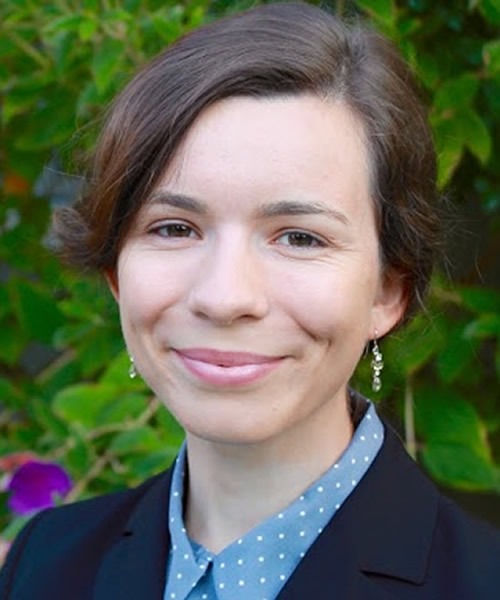


Olivia Wilkinson, Joint Learning Initiative on Faith and Local Communities

Dr. Olivia Wilkinson is the director of research at the Joint Learning Initiative on Faith and Local Communities. Her research focuses on secular and religious influences in humanitarian action, and she is the author of Secular and Religious Dynamics in Humanitarian Response (2020).
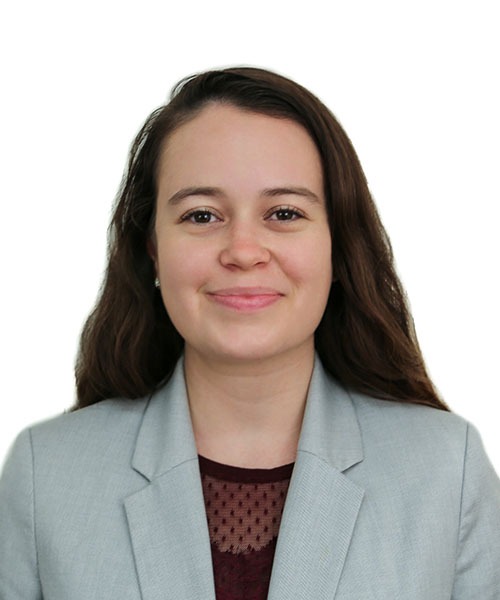


Ruth Gopin, Berkley Center for Religion, Peace, and World Affairs

Ruth Gopin is the Berkley Center’s events and projects manager. Before joining the Berkley Center in August 2019, Ruth worked as an independent contractor for the World Faiths Development Dialogue. She holds a B.A. in international development studies from McGill University.



Sarah Thompson, World Faiths Development Dialogue

Sarah Thompson is a Project Manager for Bangladesh at WFDD. She has a bachelor’s degree in Sociology and Gender Studies from Roanoke College and a master’s degree in International Development with Migration from the University of Kent’s Brussels School of International Studies. Prior to joining the WFDD team, Sarah worked in the education and NGO space in both China and Cambodia and recently at Georgetown’s Institute for Reproductive Health focusing on family planning interventions in Nepal. Sarah has a strong interest in the intersection of religion, development, and gender equity in South Asia.



Peter Yeboah, Christian Health Association of Ghana

Peter Kwame Yeboah is the executive director of the Christian Health Association of Ghana (CHAG), which is the second largest provider of health services in Ghana. His areas of expertise, interest, and experience include: health systems strengthening/development, social policy, health sector policy planning, health care financing, and community-based PHC.


Accompanying Publications:

Watch the first webinar of the series: Faith Engagement & COVID-19: What really works? and the third one: Two-year updates from National and Regional Faith Actor COVID-19 Responses.
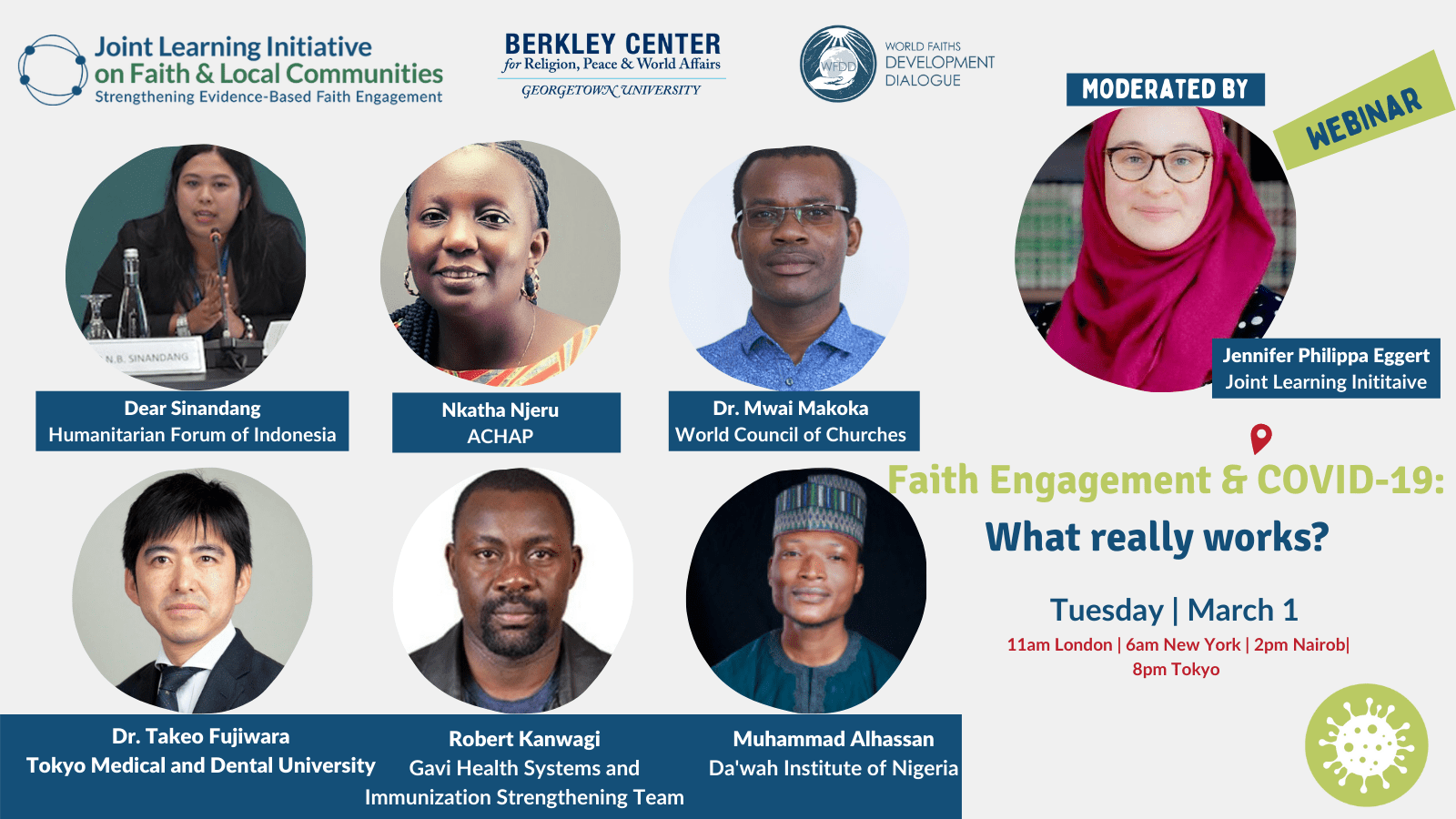
Looking back to look forward: COVID-19 and Faith Reflections on 2020-2021 Webinar Series

JLI’s year-long collaborative learning process culminated on Tuesday, March 1, 2022, with a webinar that brought representatives of the faith actors who had participated in the research into dialogue with key external partners, discussing where they have seen growth and where problems remain with faith engagement.


Three representatives of the collaborating faith actors began by sharing what they felt was the most important message from the report. Nkatha Njeru, from African Christian Health Associations Platform, began by highlighting the importance of building relationships with local faith actors before a crisis so there is already a foundational mutual understanding in an emergency. Dear Sinandang, from Humanitarian Forum Indonesia, encouraged everyone to be more courageous in forming more diverse partnerships. She spoke about the complementary role that faith actors can play to government responses and the value of diverse, interfaith partnerships. Dr Mwai Makoka, from World Council of Churches, echoed this point, using the image of each actor having their own ‘toolbox’ – unique capabilities, approaches and assets to respond to global challenges – to emphasise the need for actors to value one another’s differences and contribution when building trusted partnerships. In his experience, problems come when stakeholders only want to work with others who share all their values and ways of working – for example, donor agencies being suspicious of faith groups’ methodologies, or faith groups distrusting government. Yet in the diversity of methodologies, principles, and convictions, holistic solutions can be found when each actor proactively seeks and harnesses areas of convergence.

Three representatives of key external partners, nominated by participants, then commented on the research findings from their experience. Robert Kanwagi, currently working with GAVI, spoke about the significant harmonisation during COVID in this area, as governments and secular development agencies saw the vital role of faith actors with increasing clarity. He also confirmed from his experience that faith actors were still often engaged in times of crisis, not seen as long-term strategic partners, for example on climate change. He saw a united interfaith voice about the unique value that faith brings to the table as a vital step to ensuring their inclusion in global partnerships on every issue. Dr Takeo Fujiwara, a Professor at Tokyo Medical and Dental University, affirmed the value of faith actors’ contribution, especially in bringing unity, cultivating empathy and tackling misinformation. Finally, Muhammad Alhassan from the Da’wah Institute of Nigeria shared his experience. He had seen significant growth through COVID-19 in proactive local partnerships between faith actors and with secular agencies, with new collaborations and networks formed. He emphasised the influence of faith actors in many communities, and the danger where they are not equipped to differentiate misinformation, emphasising the necessity of capacity development. He too concluded with the need to sustain long-term, healthy relationships with local faith actors in times of peace that can be drawn on in a crisis.

Each panelist then reflected on one key learning they would take forward in their own organisation, from breaking silos and focusing on diverse, long-term partnerships to strengthening internal learning processes to developing the capacity of grassroots faith groups to respond themselves and connect to their communities.

Read the Lessons Learned: Faith-Based COVID-19 Response Report

Watch the second webinar of the series: Faith and the COVID-19 Pandemic at Two Years: A Retrospective and the third one: Two-year updates from National and Regional Faith Actor COVID-19 Responses.


On February 10, 2022, JLI held a webinar where Dr. Julia Berger, Montclair State University, presented on ‘Ideas, Religion, and Social Change: The Baha’i International  Community and the United Nations‘. Misbah Hyder, University of California-Irvine responded followed by a Question and Answer session.

View the presentation slides here

On January 13, 2022, JLI held a webinar where Dr. Romina Istratii, SOAS University of London, presented on ‘Working with religious communities to address domestic violence in peace and war-time: Insights from project dldl/ድልድል in Ethiopia’. Mr. Henok Hailu Ayele, College of Health Sciences, Department of Psychiatry (Black Lion Hospital), Addis Ababa University, Ethiopia responded followed by a Question and Answer session.

The session was based on Dr. Istratti’s recent short blog essay and a Faith, culture and social norms chapter from her book: Adapting Gender and Development to Local Religious Contexts – A Decolonial Approach to Domestic Violence in Ethiopia.

View the presentation slides here

On December 9, 2021, JLI held a webinar where Seb Rumsby, University of Warwick, presented his paper on ‘Hmong Christianisation, the Will to Improve and the Question on Neoliberalism in Vietnam’s Highlands’.  Emma Tomalin, Unversity of Leeds and JLI Board member, responded followed by a Question and Answer session.

Click here to register and view the list of upcoming webinars.

On November 11, 2021, JLI held a webinar where John Blevins, JLI Board member and Director of Interfaith Health Program at Rollins School of Public Health at Emory University, presented his paper on ‘COVID-19 and the Politics of Life and Death’. The paper examines the influences of religion on community perceptions of COVID-19. Katherine Marshall, Executive Director of the World Faiths Development Dialogue (WFDD) responded followed by a Question and Answer session.

Click here to register and view the list of upcoming webinars.

In the DSA 2021 Annual Conference, a research/practice roundtable brought together researchers and practitioners to discuss the nexus of decolonisation, development and faith. The panel was held over three days on June 28, 29 and 30 of 2021.

This roundtable focused on the nexus of decolonisation, development and faith. Debates on anti-racist and decolonised approaches amongst development/humanitarian researchers and practitioners acknowledge that local communities are central agents in their own liberation, yet they continue to be marginalised in decision-making and resource allocation by large parts of the international aid/development sector. The majority of people worldwide identify with a faith. The role of faith is often particularly strong in the ‘Global South’. Local capacities, social capital, leadership, expertise, networks and service provision are often faith-based. Ignoring the contribution of faith in development/aid devalues pivotal dimensions of people’s lived experiences and diminishes their sources of power, legitimacy, accountability and resilience. An inability to speak authentically as faith actors contributes to the erasure of non-white cultures and non-Western faiths. Yet faith actors are not immune from anti-racist and decolonial critique, and often have complex and contested histories that involve colonialism, missionaries, and conversions. Faith communities have a mixed record when it comes to challenging racism and other forms of systemic discrimination. Faith-based organisations perpetuate the same white supremacist culture and racist and (neo)colonial development and faith legacies as the broader aid/development sector, by failing to acknowledge colonial legacies, neo-colonial practices, the dominance of Western theological constructs, complicity in broader racist structures, and hierarchical power dynamics. Research on religion and development has not sufficiently contended with these concepts, if at all. This panel aims to give a higher profile to this much needed debate.

Convenors:

  • Emma Tomalin, University Of Leeds
  • Jennifer Philippa Eggert, Joint Learning Initiative on Faith and Local Communities (JLI)

June 28 Panel:

June 29 Panel:

June 30 Panel:


View the full Conference Programme

More information on the DSA 2021 Conference can be found on the DSA website

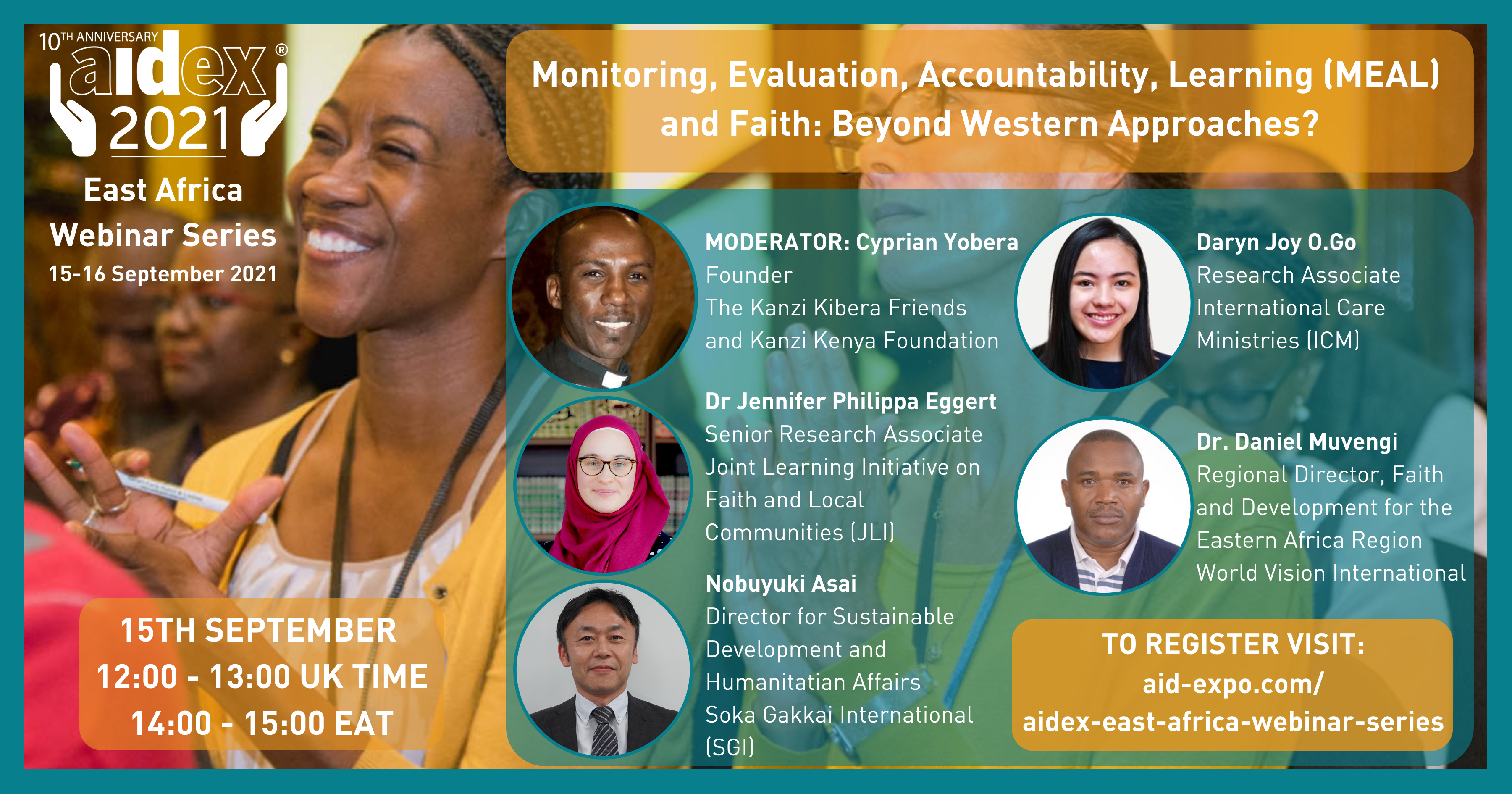
JLI Senior Research Associate, Jennifer Philippa Eggert organized a panel discussion in AidEx Nairobi webinar series on 15 September 2021.

The series had a wider focus on East Africa, and the theme was: ‘The impact of COVID-19 on East Africa, the need for better healthcare systems, lessons learnt and building future resilience’.  As part of the series, JLI co-organized the following webinar on MEAL and faith.

View the playback of the session here

Monitoring, Evaluation, Accountability, Learning (MEAL) and Faith: Beyond Western Approaches

What are good practices and lessons learned when doing Monitoring, Evaluation, Accountability, Learning (MEAL) in partnerships with/as local faith actors? What are some of the challenges and opportunities in this area? Is there space for fair, equitable and local approaches, including those that go beyond formalised Western frameworks?

Speakers:

  • MODERATOR: Reverand Cyprian Yobera, Founder, The Kanzi Kibera Friends and Kanzi Kenya Foundation
  • Daryn Joy O.Go, Research Associate, International Care Ministries (ICM)
  • Nobuyuki Asai, Director for Sustainable Development and Humanitatian Affairs, Soka Gakkai International (SGI)
  • Dr. Daniel Muvengi, Regional Director, Faith and Development for the Eastern Africa Region, World Vision International

View the full webinar series here


On October 14, 2021, JLI held a webinar where Philip Fountain, Victoria University of Wellington, and Edoardo Siani, University of Venice, chapter authors of Political theologies and development in Asia: Transcendence, sacrifice, and aspiration (Manchester University Press; 2020) presented their chapters followed by a Question and Answer session.

Click here to register and view the list of upcoming webinars.

On September 28, 2021, The JLI Anti-Trafficking and  Modern Slavery Hub, University of Leeds, and the IAHT Network co-hosted a conversation with Researchers, International Practitioners and Participants on how international anti-trafficking practitioners have adapted their responses to the unprecedented challenges of COVID-19 and in particular, the role of faith actors during a time of crisis.

Watch the recording below which included critical learnings from the new research report: How has the International Anti-Trafficking Response Adapted to COVID-19?

Participants:

  • Tina Dedace – President of SHE Works, a local organisation in the Philippines supporting trafficked survivors
  • Dr. Nehemiah Bathula and Ezra Bathula – both who run a house church in India and responds to modern slavery and human trafficking
  • Caleb Ng’ombo – Executive Director at People Serving Girls at Risk, a local sex trafficking abolitionist organization in Malawi