Engaging with Faith Organizations and Communities for Sustainable Development
UNSSC Knowledge Center for Sustainable Development part of the UN System Staff College
November 15-17 in Bonn, Germany.
The course covered the following objectives:
Increasing understanding of the linkages between faith, development and humanitarian work in the context of the Agenda 2030
Identify and articulating opportunities, challenges and modalities for UN partnerships with religious communities and faithbased organizations in development and humanitarian work
Critically assessing current UN and development/humanitarian agencies’ collaborative partnerships with religious institutions and faithbased organizations and identifying the key elements needed to strengthen such partnerships.
For more information please see the flyer or on the UN System Staff College website here
JLI is pleased to announce the Evidence on the Role of Faith in Poverty Reduction Conference at Yale University partnering with International Care Ministries (ICM), Yale University and Innovation for Poverty Action (IPA). Join us to learn from IPA’s analysis and comprehensive examination of the impact of faith on poverty reduction.
Dates and Locations:
September 20 (8am-5:30pm EDT) Maurice R. Greenburg Auditorium
September 21 (8:30am-12pm EDT) Dwight Chapel
Conference speakers include:
Dean Karlan, Mark Brinkmoeller, Arnie Cole, David Sutherland, Julian Jamison, Mark Forshaw, Matthew Frost, Ulrich Nitschke, Bishop Efraim Tendero, Jean Duff, Sneha Stephen, Chris Udry, Dan Williams, Lincoln Lau, Adam Taylor, Bruce Wydick and Ed Stetzer
The World Bank Group Faith Initiative, the United Nations Inter-Agency Task Force on Engaging with Faith-Based Organizations for Sustainable Development, the International Partnership on Religion and Sustainable Development (PaRD) as well as religious and faith based organizations including the World Council of Churches, Islamic Relief Worldwide, ACT Alliance, Caritas Internationalis, American Jewish World Service and the Global Interfaith WASH Alliance are pleased to invite you to participate in
On January 19–20, 2017, the Harvard Divinity School held a symposium on religious literacy in humanitarian action. The plenary panel featured JLI Board members Katherine Marshall, Anwar Khan, and Jean Duff, JLI Advisory Group members Vinya Ariyaratne, Nobuyuki Asai and Azza Karam as well as hub members Alastair Ager and Tahir Zaman.
Panel on Infectious Disease (From left: Stephen Prothero, Jean Duff, Katherine Marshall, Rudelmar Bueno de Faria) photo credit: Bud Heckman
What are the strengths and drawbacks of both secular and faith based organizations (FBOs) in humanitarian action?
How does a focus on humanitarian leadership shape how organizations understand the roles of religions and engage religious actors in local contexts?
What are the implicit and explicit assumptions about religion in different humanitarian aid organizations?
What kinds of training regarding religion do humanitarian aid workers receive in different organizations?
What are participants’ experiences of the ways funding bodies respond to applications for humanitarian projects and programs that engage with religion?
As an individual practitioner or researcher working in the field of humanitarian action, how do you think about the roles that religions play in your work?
Katherine Marshall started the session by commenting on how health and faith been one of the most productive and potentially one of the most important topics. She gave an overview of what faith contributes to the protracted humanitarian crisis of HIV. She followed with examples of challenges and lessons learned in engaging faith inspired actors.
Jean Duff followed expanding on key areas of engagement with case studies and emphasizing mechanisms and how faith-based organizations could be engaged and their vital role as intermediaries, especially between local actors and national, bi-lateral and multi-lateral organizations.
Rudelmar described the World Council of Churches’ (WCC) historic involvement in the HIV/AIDS epidemic. Emphasizing key recommondations in engaging FBOs.
Panelists gave an overview of Cyclone Nargas in Myanmar. Then they framed the role of FBOs in response to disasters from their experiences highlighting local humanitarian leadership and conflict dynamics and sensitivities heightened by the disaster.
Panelists gave an overview of the religious make up of the Sudan and emphasized the diversity of the cultural identity and the challenge it brings. Then discussed the role of FBOs in the crisis. How religion and religious sentiment has allowed itself to be coopted. Also, how religious literacy must include some tools for navigating and addressing engagement and the lived religious experience of beneficiaries.
Panelists spoke about the current crisis in Syria, the impact on local persons and how religion is at the center. How society expects more from FBOs especially as they are the oldest provider of social services. If humanitarianism and religion are compatible and what would it take to integrate the two. As conflict continues to arise and become more protracted in many areas, he commented that you cannot be hosts forever. We need to consider how to get our neighborliness back.
His Majesty Otumfuo Nana Osei Tutu II, King of the Kingdom of Asante
Chair: Bishop Trevor Mwamba, Bishop of Botswana, (2005-12)
Overview
As the demographic patterns of African states ebb and flow, adherents of different faiths increasingly find themselves living side by side. Religious belief is deeply ingrained in many African societies. While Muslims, Christians, traditionalists and followers of other faiths coexist peacefully in most of the continent, environmental, economic and security pressures have led to the rise of religious extremism in certain areas. As a result, the need for sustained and meaningful interfaith dialogue has never been greater.
At this event, His Majesty Otumfuo Nana Osei Tutu II will address the need to promote mutual understanding and implementation of confidence-building measures between faiths, and will discuss how religious institutions and leaders can mediate at times of conflict in African countries.
The Centre for Religion, Conflict and the Public Domain and Sustainable Society, University of Groningen and the Knowledge Centre Religion and Development, Oikos will be hosting a two-day workshop in The Hague, 25-26 June, 2015. The event “The spiritual is political: Exploring transformations in religion and development,” will explore questions how and why do religion and spirituality matter in development, with policymakers, practitioners and researchers working for a range of different institutions and organisations related to and interested in development attending.
McKinsey in conjunction with JLIF&LC has released a new report “Building Effective Partnerships between Public Sector and Faith Groups,” in preparation for the July Religion and Development conference on the same topic. The conference will take place on 8th and 9th July 2015 in Washington, DC and will be co-hosted by the World Bank Group, the German Federal Ministry for Economic Cooperation and Development (BMZ), the United Kingdom Department for International Development (DFID) and the United States Agency for International Development (USAID) in collaboration with JLIF&LC and others.
Act Alliance, Islamic Relief Worldwide, Soka Gakkai International, and Tearfund released a statement on the role of faith-based organizations in disaster-affected communities at the UN World Conference on Disaster Risk Reduction, 16 March, 2015.
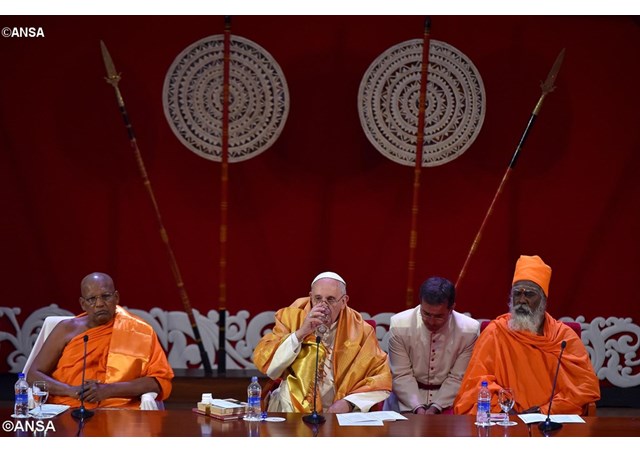
Pope Francis attends an interreligious event in January during his Apostolic Journey to Sri Lanka. – ANSA
The Holy See delegation at the United Nations co-sponsored a panel on “The Relevance of Interreligious and Inter-Civilizational Dialogue to the Post-2015 Sustainable Development Goals,” Friday, March 27, 2015.
Archbishop Bernardito Auza, Permanent Observer of the Holy See to the United Nations, spoke about the role of religions and faith-based play in the eradication of poverty. Auza said religious organizations are at an advantage in the fight against poverty, having both “grassroots-level credibility” and being “universally networked.”
View the original story at Vatican Radio here to read more on the panel and the full intervention of Archbishop Auza.
The latest in the C3 series of International Breakfast Seminars will be held on Friday 27 February on the topic How faith-based organisations can contribute to chronic disease prevention. It will be given by global health leader Dr Stephanie Ferguson, member of the Institute of Medicine, and director of the ICN – Burdett Global Nursing Leadership Institute in Geneva, Switzerland.

 Panel on Infectious Disease (From left: Stephen Prothero, Jean Duff, Katherine Marshall, Rudelmar Bueno de Faria) photo credit: Bud Heckman