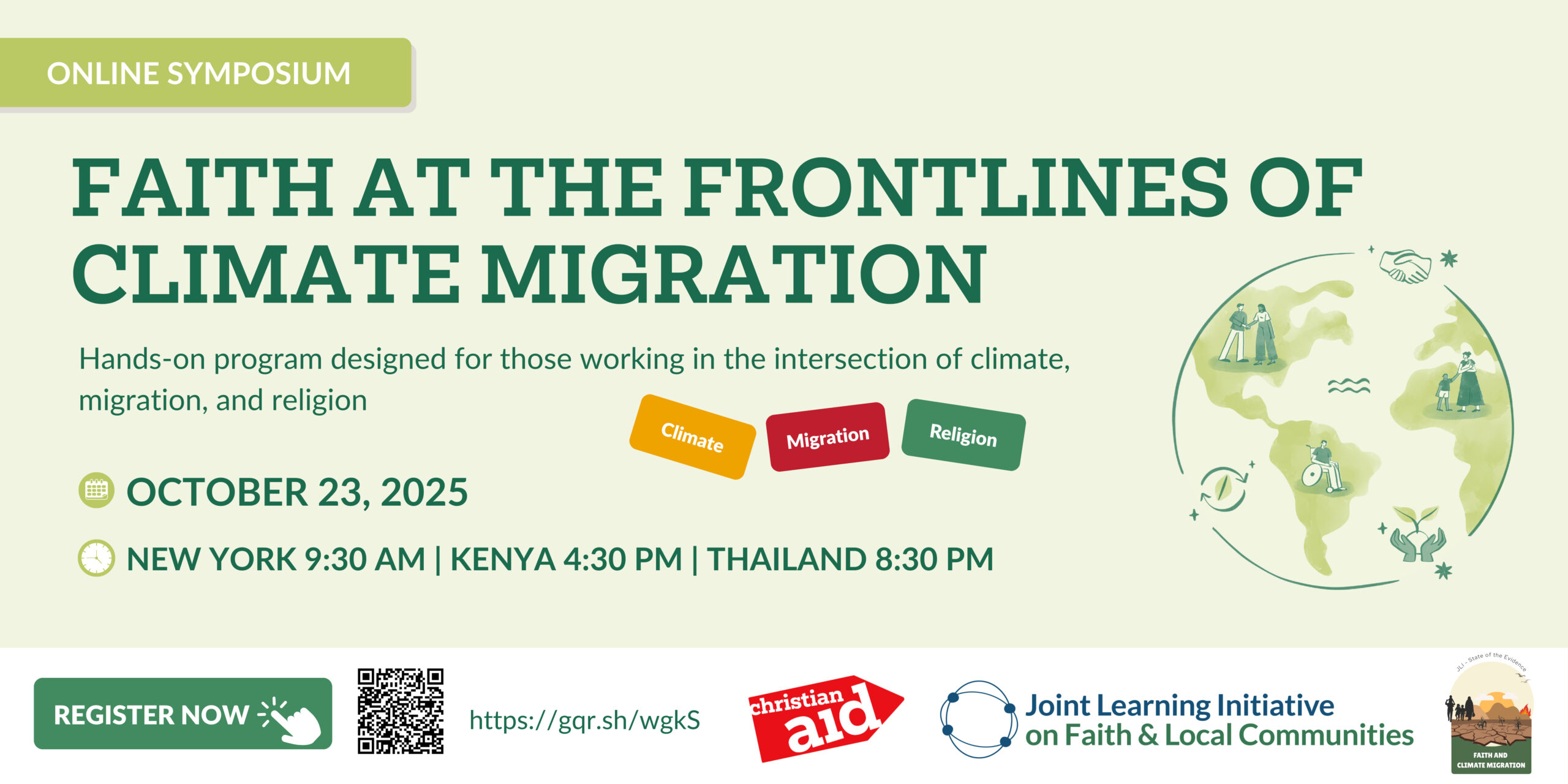
Join JLI and Christian Aid for a dynamic online symposium exploring how faith actors are responding to the human realities of climate-driven migration, and how we can build partnerships for resilient, community-rooted action.
Climate migration is no longer a distant scenario. Around the world shifting rainfall patterns, flooding, droughts, and heatwaves are forcing people from their homes through slow-onset pressures and sudden, catastrophic events. The human consequences are profound. Climate-induced migration affects livelihoods, people’s health and identity. Current knowledge on this growing crisis largely overlooks faith actors, even though they offer material aid, emotional support, spiritual guidance, and a sense of belonging to people facing displacement.
The symposium will provide a framing of why and how sacred ties to land and community shape migration decisions. Participants will engage directly with the latest insights from the JLI-Christian Aid Evidence Review on Faith and Climate Migration and three regional Listening Dialogues (a participatory research tool) from South Asia, East Africa, and Latin America and the Caribbean.
Registration closed
Who Should Attend
This hands-on program is designed for those working in the intersection of climate, migration, and religion. Special invitation to voices from regions most vulnerable to climate shock.
Registration closed
Key Features
- High-level Keynote Address
- Plenary Panel
- Summaries of regional evidence, gender & equity insights, and barriers to faith inclusion.
- Breakout Workshops: Early‑Warning Collaboration, Micro‑Grant Modeling , Inclusive Adaptation Roundtable
- Virtual Poster Session & Networking
- And more…
Meet our Speakers!

Father Eric Iván García, Keynote Speaker
Father Eric Iván García Concepción, a priest of the Diocese of Mayagüez (Puerto Rico), currently serves as Assistant Secretary of the Latin American and Caribbean Episcopal Council (CELAM). He holds extensive academic training: a Master of Divinity from the Saint John XXIII National Seminary in Massachusetts (USA), studies in Nonprofit Organization Management from the University of the Sacred Heart (Puerto Rico), and a Bachelor of Business Administration with a concentration in Organizational Studies from the University of Puerto Rico, Mayagüez Campus. He was a professor at the Pontifical Catholic University of Puerto Rico.
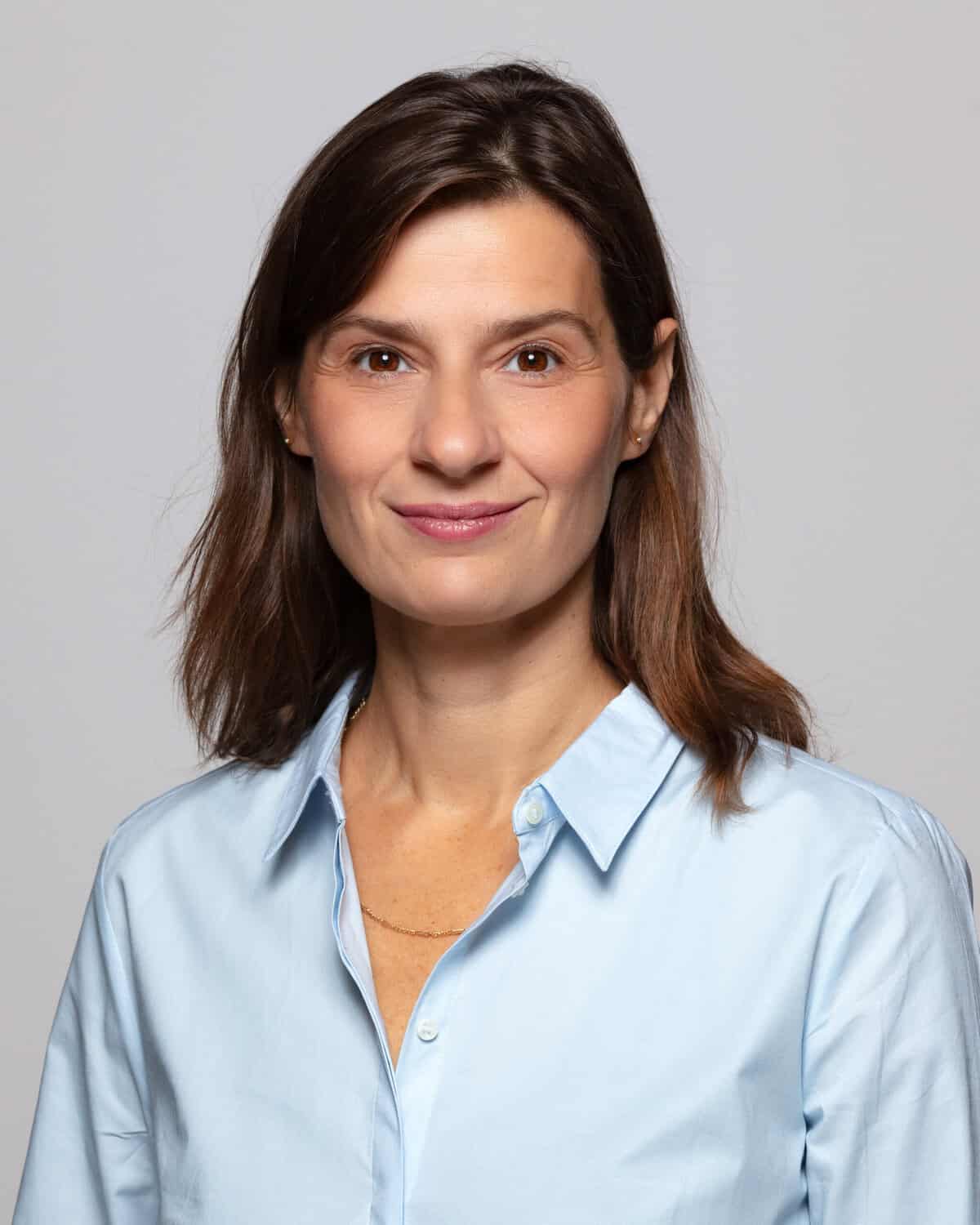
Dr. Katherine Braun
Dr. Katherine Braun is a climate-induced displacement consultant for the Lutheran Church in Northern Germany and the chair of the Climate-Induced Human Mobility Working Group at ACT Alliance. She supports and advises faith-based and civil society organizations, and she advocates at UN climate negotiations (UNFCCC), particularly on economic and non-economic loss and damage, adaptation, and human rights. Dr. Braun is a member of the UNFCCC Advisory Group on Human Mobility and Climate Change and has authored several studies on the topic.

Mr. Sheikh Nur Ataya Rabbi
Mr. Sheikh Nur Ataya Rabbi is working with CPRD as Assistant Manager- Research and Advocacy. With a bachelor’s and a master’s degree in Economics and a keen interest in economic and development theories and policy analysis, Mr. Rabbi specializes in conducting in-depth research on macroeconomic trends and their impacts on the economy, and climate change and development nexus. His expertise lies in qualitative and quantitative research methods, data analysis, econometric modelling, and the synthesis of complex information into actionable insights. He has extensive experience of research on diverse issues relating to climate change and sustainable development, including, climate change adaptation, loss and damage, human rights, displacement and migration, etc., and also a notable publication record in national and international peer-reviewed journals. With his attention to detail and commitment to excellence, Mr. Rabbi is passionate for becoming a thought leader in the arena of development research and climate advocacy

Dr. Jodie Salter
Jodie Salter is an independent researcher and consultant specialising in the social and religious dimensions of climate change. She has worked with the JLI, and with a number of international faith-based organisations and NGOs on projects related to (local) faith actors, climate, development, and environmental sustainability. She has previously worked as a social scientist for the Forestry Commission in the UK. Jodie holds a PhD in Religious Studies and an MA in Religion and Public Life from the University of Leeds. For her PhD, she conducted sociological research on the role of faith actors in climate action and advocacy at the UN, with a focus on COP26, the UNFCCC, and the UNEP.
Agenda
Symposium Rationale & Welcome
5 mins
The JLI-Christian Aid Climate, Faith and Migration research shows that local faith communities are already acting as first responders, issuing early warnings, mobilizing volunteers, and running food kitchens and shelters, long before formal aid arrives. This symposium aims to turn findings into action by convening a diverse audience to learn, collaborate, and commit to strengthening faith-led resilience.
High-level Keynote Address
10 mins
“Climate Justice and Compassion: A Call to Conscience”
Speaker: Father Eric Iván García, Deputy Secretary General at the Episcopal Conference Latin America and the Caribbean
Plenary Panel
45 mins
45-minute facilitated discussion and Q&A to summarize key LAC, Africa and Asia findings. Early warnings, evidence needs, Gender, networks, long-term accompaniment. Discuss barriers to faith inclusion in formal adaptation plans. Highlight opportunities for partnership between policymakers and faith groups.
Breakout Workshops
80 mins
Participants choose one of three interactive tracks:
1. Early-Warning Collaboration for a fictionalized case study
- Objective: Co-design a simple protocol for faith networks to co-design and contribute local weather and flood alerts into national systems.
- Activity: In small groups, map communication flows and assign roles for example local pastor, traditional religious leader, meteorologist, municipal official. They’ll produce a one‑page protocol that any faith network could follow in a real warning situation and that national systems could slot in.
2. Micro-Grants for Faith Responders
- Objective: Draft the outline of a USD 5,000 “Rapid Response Fund” proposal for congregations to improve climate resilience locally led projects.
- Activity: Teams define funding criteria, oversight mechanisms, and reporting templates.
3. Inclusive Adaptation Roundtable
- Objective: Co-design two policy clauses that integrate faith actors into national climate-migration responses such as early-warning systems, and corporate-faith CSR partnerships.
- Activity: Participants split into Government, Donor, and Fossil Fuel teams using one-page briefs; each group negotiates clauses for 40 minutes; then each team presents its agreed policy clauses in a 5 minute plenary showcase.
All participants come back to plenary and share their work with the group.
Virtual Poster Session & Networking
40 mins
All participants can browse digital poster “booths.” Each booth will have 4 minutes to present their poster. Presenters remain online for live Q&A. The platform’s breakout-in-breakout feature allows one-on-one or small-group conversations, fostering new research and operational partnerships.
Closing Reflection & Faith-Climate Pledge
40 mins
A 40-minute plenary reconvenes to:
- Synthesize workshop outputs/share top early-warning protocols, inclusive adaptation, and micro-grant designs.
- Invite participants to co-create a Faith-Climate Pledge (to be built post symposium) , outlining three actionable commitments for governments, donors, and faith communities (e.g., fund faith-led adaptation, include faith voices in policy forums, document local resilience).