Organizations listed here include academic institutions, community health and development organizations, and health and development policy groups who are not yet members of JLI F&LC but have a wealth of experience and wisdom when it comes to faith groups’ activities and contributions to local community health and well-being.
Please refer to them and share these important resources with your networks.

Cord

Cord was founded in 1967 in response to the news that thousands of orphans were being left homeless as a result of the Vietnam War. The organisation’s founders, Pat and Marion Ashe, alongside a congregation of St Mary’s church in Leamington Spa, wanted to see lives saved and transformed in this situation so far removed from the United Kingdom. In this way Cord began as a personal expression of both love and faith. Working on the ground and taking a personal stance, Pat and Marion Ashe approached the situation with a commitment to helping transform one life at a time.

For the past 13 years Cord’s work has focused on addressing inequality, marginalisation, and exclusion, issues that fuel tension between communities and that can lead people to resort to violence as a way of settling their grievances

Cord beliefs

Cord is rooted in the Christian gospel message of inclusion, justice and accountability. We are not a proselytising organisation, and whole heartedly believe in showing respect, kindness and promoting a sustainable peace with those of all faiths and none. We believe that faith without actions is dead, and since 1967 have conducted practical programmes that relieve poverty and promote social cohesion. Working collaboratively with other organisations, our Christian ethos is central to our work, without discrimination nor equivocation. Cord is a founding member of EU CORD – a collective group of European Christian development agencies.

View website

Cordaid

The overriding challenge in fragile and (post-)conflict countries is restoring trust and social cohesion, at community level and between communities and the state. This is what Cordaid does, right in the heart of communities, by mobilizing global networks, resources and knowledge. By doing this, we help people move beyond survival and live in dignity.

Cordaid does not accept this world of inequality, exclusion and unsustainability. We envisage a world where the basics of a life in dignity are available to all. Where the poorest and the excluded can influence the decisions that affect them. Where each person is free to flourish and can live in peace.

Cordaid is the Catholic Organization for Relief and Development Aid. Inspired by compassion, solidarity and subsidiarity, we see it as our mission to reduce fragility and the vulnerability of people where it is most needed and most difficult: in fragile and conflict-affected societies.

View website

DICASTERY for Promoting Integral Human Development

The Dicastery promotes the integral development of the person in light of the Gospel and in line with the Social Doctrine of the Church. It dedicates particular attention to taking care of the goods of justice, peace and the safeguarding of Creation, as well as issues regarding disarmament, human rights, human mobility, health, charitable works, expressing the concern and attention of the Pope towards a humanity that suffers, among whom are the needy, the ill and the excluded. In addition, the Dicastery follows issues regarding the necessities of those who are forced to abandon their own countries or those who are without one, the marginalized, the victims of armed conflicts and natural disasters, prisoners, the unemployed and victims of contemporary forms of slavery and torture and other people whose dignity is at risk.

View website

Digni

Digni is an umbrella organization that annually receives 160 million NOK (Norwegian kroner) from the Norwegian Agency for Development Cooperation. The money is distributed to more than 100 development projects. Digni ensures that the money is well spent and that projects are performing well.

Faith Affiliation: Inspired by principles of Christianity

Key Facts: Digni is made up of about 20 different Christian organizations. With the help of 7,000 employees and 300,000 volunteers, Digni was able to reach 750,000 beneficiaries in around 35 different countries this past year.

Interview: The Berkley Center Religion, Peace and World Affairs at Georgetown University had a discussion with Digni secretary general, Jørn Lemvik. Click here for discussion

View website

Eastern Mennonite University

EMU offers rigorous academic study at the undergraduate, graduate and seminary level. More than 1800 students study at our main campus in Harrisonburg, Virginia; at our Lancaster, Pennsylvania site; and online. EMU is grounded in values including service to others, peacemaking, cross-cultural engagement and sustainability, all of which prepare graduates to serve and lead in a global context.

Center for Justice and Peace

www.emu.edu/cjp

View website

Ecumenical Advocacy Alliance

The Ecumenical Advocacy Alliance is an international network of churches and church-related organizations committed to campaigning together on common concerns. Current campaigns focus on HIV and AIDS and Food. Our advocacy includes raising awareness and building a movement for justice within the churches as well as mobilizing people of faith to lobby local and national governments, businesses, and multi-lateral organizations. We partner with many organizations who share common goals on these critical issues, believing that the more we work together, the stronger our voice is for justice.

View website

Episcopal Church in the Philippines

The Episcopal Church in the Philippines exists to proclaim the good news of the Kingdom of God; to baptize, teach and nurture New Believers; to respond to the human needs by a loving service; to seek to transform unjust structures of society, to challenge violence of every kind and to pursue peace and reconciliation; and to strive to safeguard the integrity of creation and sustain and renew the life of the earth.

View website

Episcopal Relief & Development

Episcopal Relief & Development is the international relief and development agency of the Episcopal Church and is an independent 501(c)(3) organization, headquartered in New York City and with a regional office in Accra, Ghana. They work with local Anglican Communion, ecumenical partners and other local organizations to transform lives and empower communities in four core program areas: alleviating hunger, creating economic opportunities, promoting health and responding to disasters.

Faith Affiliation: Christian

Mission: All of Episcopal Relief & Development’s international development programs seek to mobilize local resources and expertise toward sustainable, community-led programs that address poverty, hunger and disease. In disaster response and recovery work, they seek to build resilience and reduce risk at every stage.

What inspires Episcopal Relief & Development (ERD)? Their work to heal a hurting world is guided by the principles of compassion, dignity and generosity. Their mandate is from Jesus’ words found in Matthew 25:37-40 to feed the hungry, care for the sick and welcome the stranger.

Key Facts: Working in approximately 40 countries in Africa, Asia, Latin America and the Caribbean, the Middle East and the United States, ERD programs impact the lives of approximately 3 million people annually.

Key SDGs Addressed:  1, 2, 3, 5, 6, 8, 11, 13, 15 and 16.

– from the Berkley Center at Georgetown University

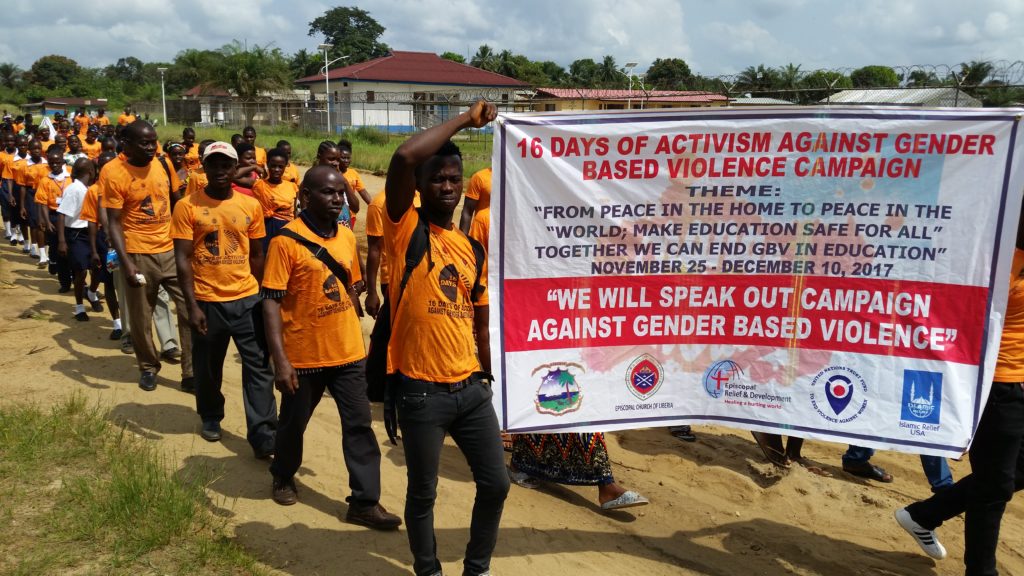
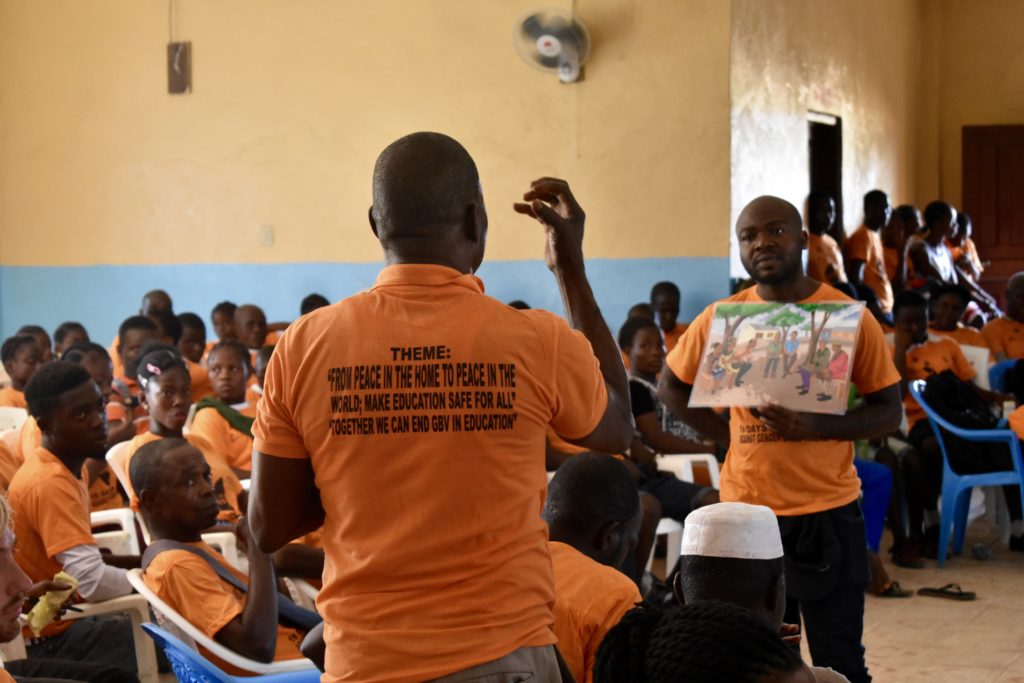
GBV Liberia Program with the Episcopal Church of Liberia Relief and Development. Photos taken during 16 Days of Activism – Nov 2017 (pc: Vanessa Pfizer)

Boima Gailor (ECLRD M&E Manager) uses a Facts, Association, Meaning and Action card (FAMA) on compromise of GBV cases to initiate dialogue from community members at 16 Days of activism rally in Cestos City, Rivercess County (Liberia). Photo credit: Vanessa Pizer, Episcopal Relief & Development

View website