
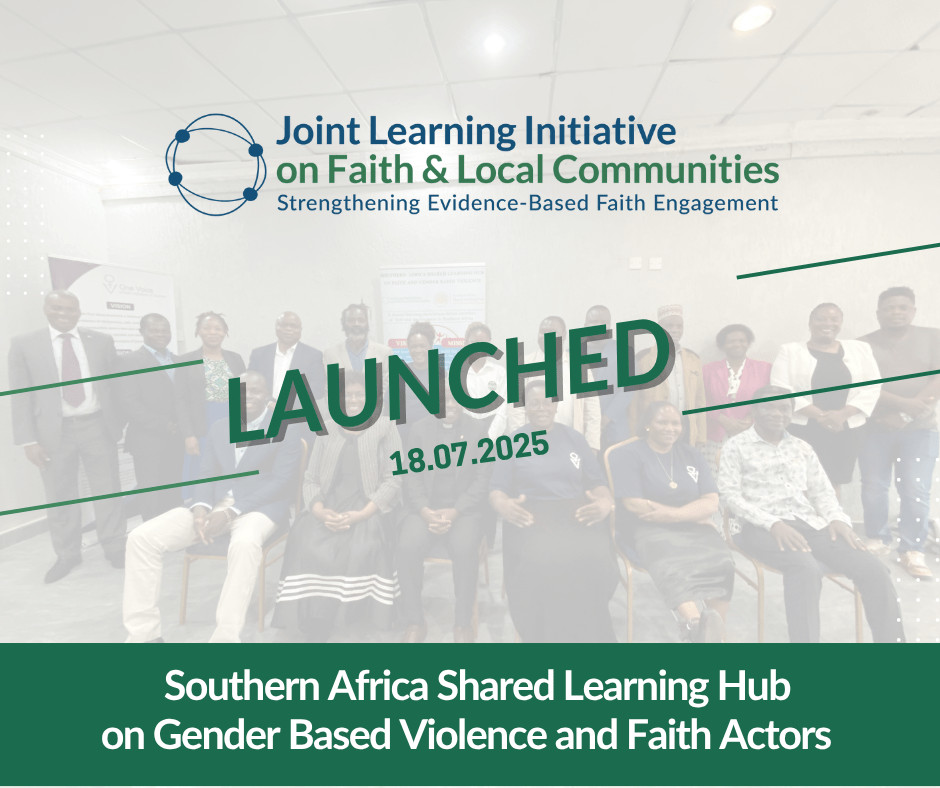





A significant step in the fight against gender-based violence (GBV) in Southern Africa was marked on July 18, 2025, with the official launch of the JLI Southern Africa Shared Learning Hub on Gender-Based Violence and Faith Actors in Lilongwe, Malawi. The Hub, established through a collaboration between the Joint Learning Initiative on Faith and Local Communities (JLI) and Speak One Voice, is envisioned as an inclusive, interdisciplinary platform for regional collaboration, learning, and action.
Drawing participants from Malawi, Zambia, and Zimbabwe, the Hub aims to address persistent research gaps, amplify local faith-based knowledge, and foster evidence-informed responses to GBV. Rooted in the belief that faith actors have a pivotal role to play in tackling violence, the Hub provides a space where researchers, policymakers, practitioners, and local faith leaders can collectively share experiences, conduct original research, and influence regional policy and practice.
Speaking during the launch, Professor Isabel Apawo Phiri, a theologian and former Deputy General Secretary of the World Council of Churches, delivered an impassioned keynote address. She emphasized the moral imperative for faith communities to be at the forefront of justice for survivors of GBV:
“As faith actors, we must begin to see with new eyes and act with bold conviction. Scripture should be read through a justice lens—one that unmasks systemic injustice, defends the marginalized, and embraces the prophetic call for gender justice and human rights. We must also humbly acknowledge the ways in which our faith institutions have contributed to gender-based violence, and use the transformative tools within our traditions to lead differently in the fights against GBV.”
The event brought together an impressive array of representatives from across the region, reflecting the Hub’s commitment to interfaith and intersectoral collaboration. Among those present were members of the Zimbabwe Council of Churches, Malawi Council of Churches, World Vision Malawi, Coalition for the Empowerment of Women and Girls (CEWAG), Muslim Association of Malawi, the Bahá’í Faith, government officials, and theologians from the University of Malawi. Participants also included development practitioners from grassroots organizations which brought unique perspectives to the shared goal of ending violence.

The Southern Africa Hub builds upon a strong foundation of regional engagement. It was conceived following a series of Listening Dialogues in Zambia and Malawi, which emerged from JLI’s 2022 State of the Evidence in Religion and Development report. These dialogues revealed both the potential and the pitfalls of religions in addressing GBV. While faith leaders are often trusted influencers, the misuse or misinterpretation of religious teachings has at times enabled silence or even justified abuse. The dialogues called for a regional learning space where these complexities could be openly discussed, researched, and acted upon which resulted in the hub’s birth.
Three core objectives will now guide the Hub’s work. First, it seeks to strengthen evidence generation by supporting collaborative, context-specific research on GBV and faith across the region. Second, it aims to facilitate knowledge exchange by creating opportunities for dialogue, reflection, and the sharing of best practices among diverse stakeholders. Third, it is committed to influencing policy and practice by ensuring that the voices and lived experiences of local faith actors are included in GBV policy processes and that faith-informed, survivor-centered approaches are promoted at both national and regional levels. As one participant reflected,
“This Hub is more than a knowledge-sharing platform, it’s a space where our faith and our evidence meet, and where we can dream of a society free from violence.”
By bringing together voices from across faith traditions, disciplines, and communities, the Southern Africa Shared Learning Hub represents a bold step forward. It reaffirms that ending GBV is not solely a legal or social issue, but also a deeply spiritual one, calling for compassion, courage, and commitment from all sectors of society.
As the event came to a close, participants left not only with new connections and tools, but also with a shared sense of purpose: to transform their faith into action that upholds the dignity, safety, and rights of every woman, child, and vulnerable person in their communities.