The leadership of the Church in the Philippines has historically exercised a powerful influence on politics and social life. The country is at least 80% Catholic and there is a deeply ingrained cultural deference for clergy and religious. Previous attempts in the last 14 years to pass a reproductive health law have failed because of the opposition of Catholic bishops. Thus the recent passage of the ‘Responsible Parenthood and Reproductive Health Act of 2012’ (R.A.
10354) was viewed by some Filipinos as a stunning failure for the Church and a sign of its diminished influence on Philippine society. This article proposes that the Church’s engagement in the reproductive health bill (RH Bill) debate and the manner of its discourse undermined its own campaign to block the law. The first part of the article gives a historical overview of the Church’s opposition to government family planning programs. The second part discusses key points of conflict in the RH Bill debate. The third part will examine factors that shaped the Church’s attitude and responses to the RH Bill. The fourth part will examine the effects of the debate on the Church’s unity, moral authority, and role in Philippine society. The fifth part will draw lessons for the Church and will explore paths that the Church community can take in response to the challenges arising from the law’s implementation.
When it comes to dealing with population growth, there are a number of misconceptions about the position of the Catholic Church. Official teaching during the twentieth century gradually moved toward the acceptance of limiting family size and endorsed the concept of responsible parenthood during the Second Vatican Council. One cannot, therefore, justifiably claim that the church is against birth control. It is an entirely different matter, however, when it comes to the practical question about how a couple might go about regulating fertility. Since the publication of Pope Paul VI’s 1968 encyclical, an intense controversy has taken place within the church about the use of artificial contraception. Behind that controversy lies an important methodological issue. For, the traditional teaching to which Paul VI returned in his letter was based upon the presumption that it is possible to morally judge a physical, material act without any consideration of the persons who performed that act, the circumstances within which it took place, or the reasons why the act was chosen. This behavioural approach to morality stands in some contrast to the way that other moral questions are dealt with. Inflicting pain or even taking a person’s life, for instance, can be justified for a good reason when one acts in a virtuous manner to instil discipline or safeguard justice. Until this methodological controversy is addressed, the problem of using artificial means to regulate fertility will not be resolved. A helpful key for solving the methodological ambiguities is to use moral language in a consistent and understandable manner.
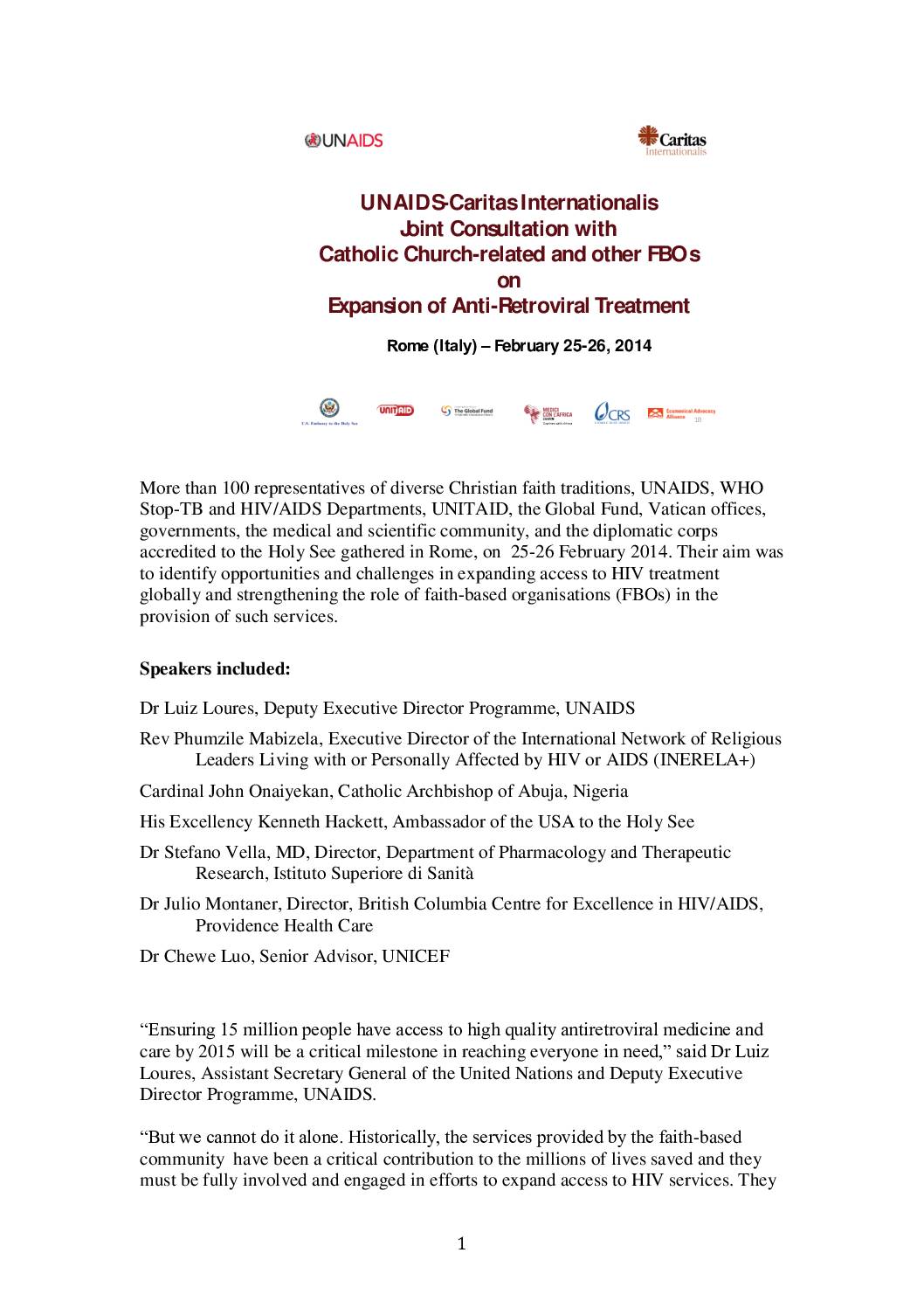
More than 100 representatives of diverse Christian faith traditions, UNAIDS, WHO Stop-TB and HIV/AIDS Departments, UNITAID, the Global Fund, Vatican offices, governments, the medical and scientific community, and the diplomatic corps accredited to the Holy See gathered in Rome, on 25-26 February 2014. Their aim was to identify opportunities and challenges in expanding access to HIV treatment globally and strengthening the role of faith-based organisations (FBOs) in the provision of such services.